The question is almost never whether a fractional CTO would help. It is what the money actually buys, because the invoice looks like a consultant and the job title looks like an executive, and nobody is sure which one they are paying for. Here is what the arrangement contains in the UAE, what it legally is, and what you should expect to be holding when it ends.
The number you are comparing it to is not a salary
Companies compare a monthly fractional fee against a monthly salary, and the comparison is wrong before it starts. A full-time technology lead in the UAE is a package: the salary, the visa and its renewals, medical insurance, end of service benefits accruing from day one, the recruiter’s fee for the search, and the notice period you will pay through if the hire is wrong. The government’s own summary of working in the private sector lists those obligations plainly, and they do not appear on the salary line anyone quotes you.
There is a second number nobody puts in the comparison: the months you spend searching. A senior technology hire in this market is not filled in three weeks, and during the search the decisions keep arriving anyway. The fractional arrangement is often bought precisely because the decisions will not wait for the recruitment process to finish.
What the arrangement legally is here, and where the exposure sits
This is the part that gets skipped, and it is the part that costs money. If the person you are engaging is employed somewhere else in the UAE, working for you as well is allowed, but it is a regulated arrangement, not a handshake. The UAE’s own guidance on working for two employers at one time is specific: a part-time work permit is obtained from MoHRE, it carries an application fee of AED 100 and an approval fee of AED 500, it runs for one year, and the second engagement is limited to fewer than eight hours a day.
And the sentence that should change how you paper this: where an expatriate is working for another company without the permit, the published penalty is a fine of AED 50,000 on the hiring company. Not on the individual. On you. The same guidance notes the part-time contract system introduced in 2018 is limited to skilled workers, meaning degree holders or holders of a two or three year technical diploma, which a technology lead will satisfy but which is worth confirming rather than assuming.
None of this applies in the same way when you are engaging a company rather than a person, which is the usual and cleaner structure: a services contract with an entity that invoices you, carries its own people, and is not your employee. The practical instruction is short. Establish which of the two you are buying before the first invoice, and if it is a person who is someone else’s employee, confirm the permit exists.
What a day actually contains
The common disappointment is buying eight days a month of what turns out to be meetings. A day that earns its fee looks different: a decision taken and written down, a vendor conversation where somebody on your side understands the answers, a review of what was built against what was asked for, and an hour spent on the thing nobody has looked at since launch.
The unit of work is the decision, not the hour. That is also how you tell whether the arrangement is functioning: at the end of a month you should be able to list what was decided, and find each of those decisions written somewhere your team can read without the consultant in the room.
The four shapes, and what each one buys
- Retained days. A fixed number of days a month, indefinitely. Buys continuity and a person who knows your history. Wasted where there is no steady stream of decisions.
- Project bounded. Attached to one build, one migration, one selection. Buys focus and a natural end. Fails where the project is a symptom and the disease is elsewhere.
- Interim. Holding the role while you recruit, with the handover to the permanent hire as an explicit deliverable. Buys time without a decision vacuum.
- Advisory. A few hours a month, reactive, for a founder who is technical enough to execute but wants a second opinion before the irreversible calls. The cheapest shape and the easiest to outgrow without noticing.
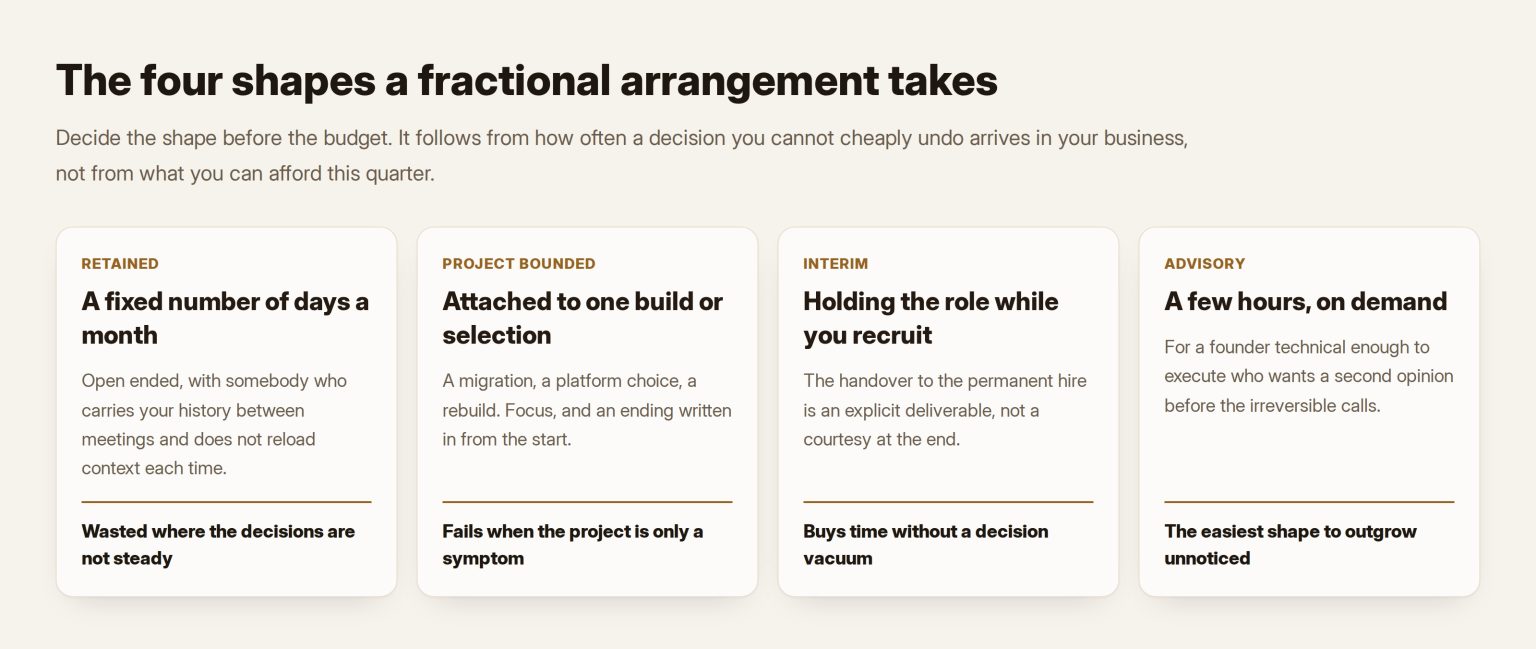
Most companies I speak to have decided the budget before deciding the shape, which is backwards. The shape follows from how often a decision that cannot be cheaply undone arrives in your business; the decisions a company pays for twice is the list of the ones that matter.
What you are really paying for
The honest description of the value is uncomfortable for an invoice: a large part of it is decisions that do not get taken. The platform not bought, the rebuild not started, the integration not deferred to after launch. None of that produces a deliverable you can photograph, and all of it is the reason the arrangement pays for itself.
The cost being avoided has a name and a literature. Martin Fowler’s technical debt describes why the interest compounds quietly, and Google’s research paper on the high interest credit card of technical debt makes the same argument for systems that learn, where the debt is in the data and the coupling rather than the code. Neither is a UAE document, and both describe exactly what a founder is buying insurance against.
What is left behind when it ends
This is the clause to negotiate hardest, because it is the difference between buying capability and renting dependence. A fractional engagement should leave artefacts that outlive it.
- A written record of every significant decision and why the alternative was rejected. The architecture decision record format exists for this and takes minutes per decision.
- An access map: who owns the domain, the cloud account, the repositories, the app store listings and the payment gateway credentials.
- A current picture of what the systems are and how they connect, in language your next hire can read on their first day.
- A vendor list with what each one is contracted to do and when the agreement renews.
- The operational review habit itself. Google’s SRE book is the long version of why a regular, boring review of how the systems behaved beats a heroic response after they fail.
If an engagement ends and none of that exists, you rented a person rather than buying a technology function, whatever the contract said.
What it cannot buy
It does not buy delivery. A fractional lead who starts writing the code has stopped doing the job you engaged, and the first sign is usually relief that things are moving. It does not buy availability: a production incident at two in the morning needs a rota, not a retainer. And it does not transfer accountability. The decisions remain yours, taken better informed. Where the work is an assessment of something already built rather than a standing role, the technical due diligence I run is the bounded version of it.
The signals you bought the wrong shape
Three, and they are easy to check. The monthly summary reads as activity rather than decisions. Your team routes questions through the consultant instead of to each other, which is dependence forming rather than capability landing. And the same topic appears in three consecutive months without resolution, which usually means the decision needs an owner inside the company rather than more advice from outside. The reason most pilots never reach production is the same pattern in a different costume: nobody internal owned it.
What the standing arrangement looks like on my side is set out on the fractional CTO services page, and the selection work it most often starts with is described in choosing an ERP or CRM when every page you find is written by a partner.
Frequently asked questions
How many days a month is actually useful?
For most companies under fifty people, somewhere between two and six, and the number follows the decision rate rather than the headcount. Below two days the person never holds enough context to be useful and you pay for them reloading it each time. Above six or eight you are approaching the cost of a full-time hire without the availability of one, which is usually the signal to start recruiting and convert the arrangement to interim cover during the search.
Do we need a part-time work permit for the person we engage?
It depends what you are contracting with. Engage a company and you have a services agreement, not an employment relationship, and the permit question does not arise for you. Engage an individual who is employed elsewhere in the UAE and the published rule applies: a part-time permit from MoHRE, under eight hours a day, renewed annually, with a stated fine of AED 50,000 on the hiring company where someone works without one. Ask the question before the first invoice rather than after, and take your own legal advice on your specific structure. I am not a lawyer.
Will our developers accept somebody senior appearing part-time?
Usually yes, and the exceptions are informative. Good engineers generally welcome someone who can settle a question that has been circling for months and who will say no to the business on their behalf. Resistance tends to come from one of two places: a developer who has been the only person who understands the system and reads the arrangement as a threat, or a team that has seen consultants arrive, produce a document and leave. Both are handled the same way, by making the first month about decisions they have been waiting for rather than an audit of their work.
What happens to the arrangement when we hire a permanent CTO?
It should shrink deliberately rather than stop abruptly. The useful pattern is a defined handover: the decision record and the access map transfer on day one, the fractional role drops to advisory for a short overlap so the new hire can ask why rather than reconstruct it, and then it ends. Writing that ending into the engagement at the start is worth doing, because an arrangement with no planned exit tends to acquire one at the least convenient moment.
How do we measure whether it is working?
Not by hours delivered. Three things tell you: the number of decisions closed rather than discussed, whether your own team can answer a question this month that they escalated last month, and whether anything that was bought or built in that period had to be reversed. The third is the most telling. A period with no reversals and a shrinking escalation list is the arrangement doing exactly what it is for, even when it feels like a quiet month.