Most first meetings with a conversational AI supplier in the UAE go the same way. The supplier shows a polished demo, the company nods, and a proposal arrives a week later scoped around what the demo did rather than what the business needs. The fix is not a better supplier. It is one page, written by you, sent before the meeting.
Here is what goes on that page, line by line, and why each line changes what a supplier can honestly propose. None of it needs technical knowledge. All of it needs a week of looking at your own conversations.
Why the first meeting usually goes nowhere
Without a brief, the supplier has to guess your volumes, your languages, your systems and your limits, so they quote for the product they already have. Two suppliers guessing differently produce two proposals that cannot be compared, and the decision falls back on which demo felt better.
A brief turns that around. Every supplier answers the same facts, the gaps in each proposal become visible, and the ones who cannot meet a line say so early instead of in month three. It is also the first document a conversational AI consultant would ask you for, so writing it yourself saves that week.
Line one: where conversations happen now, in numbers
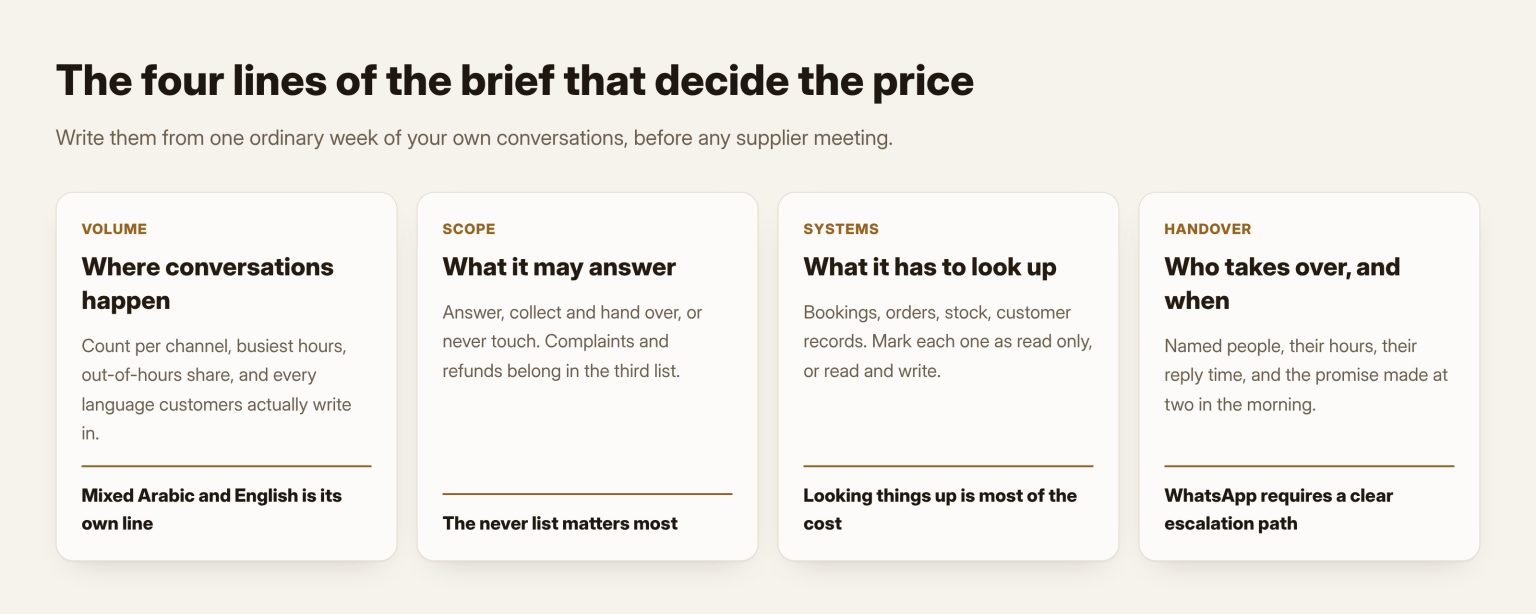
Export one ordinary week from every channel customers use: WhatsApp, website chat, Instagram messages, email, and the phone log if you keep one. Count the conversations per channel, the busiest hours, and how many arrive outside working hours.
Note the format as well as the volume. If a large share arrives as voice notes, photographs of products or screenshots, say so; an assistant that only reads text will miss those conversations entirely, and that changes both the design and the price.
Then count the languages. In the UAE that is rarely a clean split between Arabic and English. Note the share in Arabic, English, mixed Arabic and English in one message, and anything else your customers actually write in, such as Hindi, Urdu or Tagalog. A supplier who sees that number before the meeting will not promise “Arabic and English” as if that covered it.
Line two: what it should answer, and what it must never answer
From the same week, group the questions into kinds: prices, availability, order status, location and hours, bookings, complaints, refunds. Mark each kind as one of three: the assistant answers it, the assistant collects details and hands over, or the assistant never touches it.
The third list matters most. Complaints, refunds, medical or legal questions, anything involving a payment dispute: write them down. A supplier should be able to show how the system recognises each one and stops. The detailed answers come later; how to write them is set out in Tothiq’s guide to the first thirty answers to teach an assistant.
Line three: what it has to look up
An assistant that only knows a list of answers can tell a customer your opening hours. One that can read your booking system can tell them whether Thursday at four is free. That difference decides most of the cost, so list every system the assistant would need to read: bookings, orders, stock, the customer record.
Then mark whether it only reads, or also writes. Reading an order status and creating a booking are different levels of risk. Write the name of the system, who owns it, and whether it has an interface another system can use. If nobody knows, say that; it is an honest answer, and it tells the supplier where the real work is. The questions to settle before any model touches a live system are in four questions to ask before you connect a model.
Line four: who takes over, and when
Write down who receives a conversation the assistant hands over, during which hours, and how quickly they promise to reply. Then write what happens at two in the morning, on a Friday, and in the last week of Ramadan.
On WhatsApp this is not only good practice. WhatsApp’s business messaging policy allows automation within the customer service window, but requires prompt, clear and direct escalation paths, such as a transfer to a human agent or a phone number. A brief that names the people behind the handover is the brief a supplier can actually build to.
Line five: the data limits
List what the assistant may not see, and what may not leave the country. Customer names and phone numbers will pass through it; Emirates ID numbers, health details, payment card numbers and anything about minors probably should not. If any of your data has a residency requirement, say so here, not after the supplier has chosen a model hosted abroad.
The UAE’s Personal Data Protection Law, Federal Decree Law No. 45 of 2021, is the starting point, and what it asks before any model is connected is in the PDPL checklist. The brief does not need the legal analysis. It needs the list of what is off limits, so that suppliers who cannot meet it say so.
Line six: what success means, in three numbers
Choose three numbers you already measure, or can start measuring this week, and write today’s value next to each. Typical ones: the time to first reply, the share of conversations answered outside working hours, and the share handed to a person. Add one that only you can define, such as bookings made through chat.
The point is a baseline. Without it, every supplier’s results after launch look good, because there is nothing to compare them with. With it, the acceptance test at the end of the build has something to measure against, which is what the test an Arabic assistant should pass depends on.
Line seven: the budget shape, including the running cost
You do not need an exact number, but give a range for the build and say that you expect the yearly running cost stated separately. Model usage, the messaging platform and someone’s time to keep the answers current continue every month after launch.
WhatsApp alone has its own meter. Meta’s pricing for the WhatsApp Business Platform charges per delivered message, by category and market, and the free-form replies an assistant sends are only allowed inside a 24-hour window that each customer message opens. Ask every supplier to show their estimate on your own weekly volume. The full breakdown is in what an assistant costs to run for a year.
What a finished brief looks like
Here is one for an invented business, a furniture retailer in Sharjah with two showrooms, to show the level of detail that is enough. It fits on one page.
- Conversations: about 600 a week, 70 percent on WhatsApp, 20 percent Instagram, the rest website chat; a third arrive after 9 pm; 45 percent English, 35 percent Arabic, 20 percent mixed or other.
- Answers: stock, prices, delivery areas and showroom hours. Collect and hand over: custom orders and delivery complaints. Never: refunds and damaged goods.
- Looks up: stock and order status from the store system, read only. No bookings in version one.
- Handover: two named sales staff, 10 am to 10 pm, reply within 15 minutes; overnight, a promise of a call by 11 am.
- Limits: no Emirates ID numbers or card details in chat; customer data hosted in the UAE.
- Success: first reply today 2 hours on average; out-of-hours answered today 0 percent; orders started in chat counted from launch.
- Budget: a range for the build, and the yearly running cost shown separately on 600 conversations a week.
Every supplier who reads that page knows what they are pricing. Most of them will also know, within ten minutes, whether they can do it.
How to use the brief in the meeting
Send it a few days ahead and ask each supplier to answer it line by line, in writing, before they present anything. Then ask for one thing in the meeting: the demo run on twenty real messages from your own export, in the languages they arrived in, not on the supplier’s prepared script.
Compare the written answers side by side. The supplier who says “we cannot do line five without a different hosting arrangement” is more useful than the one who agrees to everything. Where the answer is to have the assistant built rather than bought, Tothiq AI Services and Solutions builds custom assistants to a brief like this one.
Frequently asked questions
How long does writing the brief take?
About a week, most of it waiting for one ordinary week of conversations to export and count. The writing itself fits in an afternoon once the numbers are in front of you.
We do not know our conversation volumes. Can we still write it?
Count one week by hand if you must, even roughly. An estimate from your own data is far better than a supplier’s assumption, and the act of counting usually shows where most questions come from.
Should the brief name a platform or a model?
No. Describe the need and the limits. Naming a product in the brief turns the meeting into a sales call for that product, and it stops suppliers from proposing something better.
Is the brief different for a website chat and for WhatsApp?
The seven lines are the same. WhatsApp adds the messaging window, the per-message cost and the escalation requirement, so be explicit about which channels the first version covers.
Should we share the brief with every supplier?
Yes, the same version to all of them. That is what makes the answers comparable. Remove anything confidential, such as customer names in the sample messages, before it goes out.