The pilot ran for six months. The clinicians liked it, the numbers were good, the sponsor said so in writing. Then the emails slowed, the follow-up meeting kept moving, and nobody will say no. Founders selling into Dubai and Abu Dhabi hospitals, government entities and large groups meet this silence so often that it deserves to be treated as a stage of the sale rather than a mystery.
Almost always, the pilot is not the problem. The pilot was approved by one person out of one budget. The contract has to be approved by a different process, out of a different budget, and very often nobody on the buyer’s side has started it.
A pilot and a purchase are two different approvals
A pilot is usually bought as an experiment: small enough to sit inside a department head’s discretion, sometimes free, sometimes paid from an innovation fund. The people who approved it were the people who wanted it.
A contract to roll it out is a purchase. It goes through procurement, legal, information security and finance, and each of those has its own rules, its own queue and no particular interest in your product. The enthusiasm that carried the pilot does not transfer automatically. Someone inside has to carry the request, and the first question to ask when the silence starts is simply: who is carrying it now, and what did they submit?
If the answer is “nobody yet”, the silence is explained. The sponsor is waiting for you, and you are waiting for them.
Are you a registered supplier?
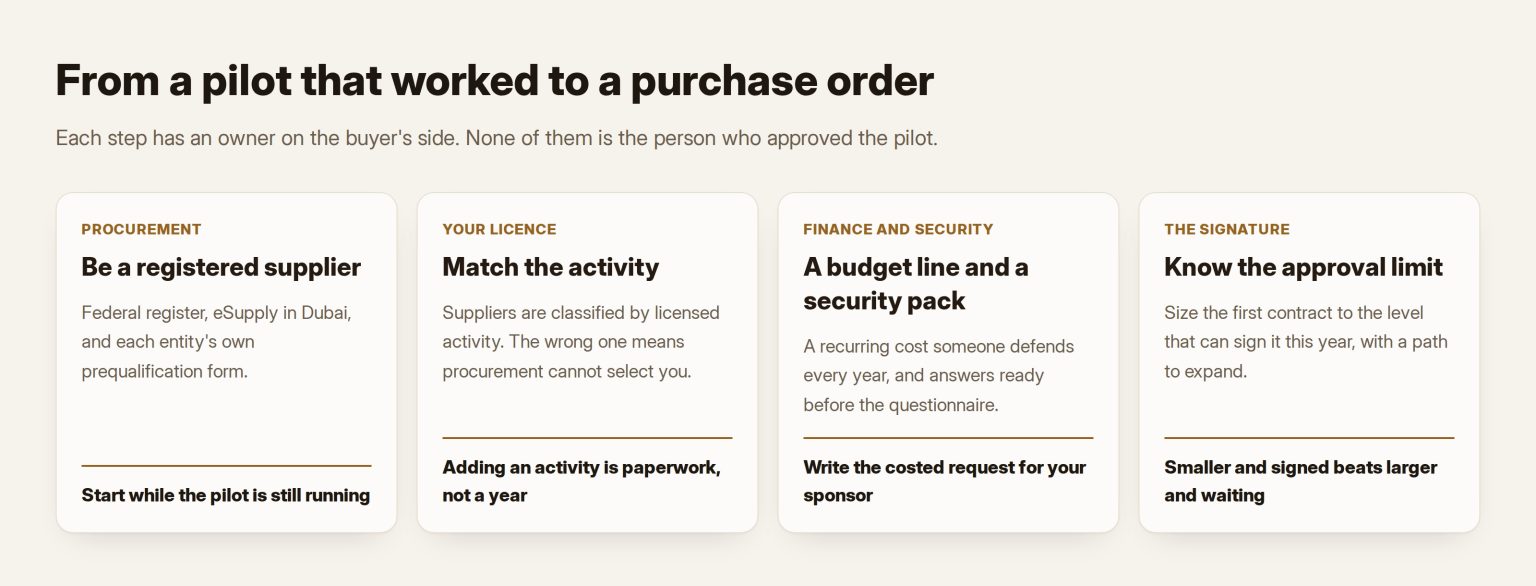
Government and semi-government buyers in the UAE can only buy from registered suppliers, and registration is not instant. Federally, companies register in the Ministry of Finance’s Federal Supplier Register, which says approval can take up to 30 working days and that registration has to be renewed every year. Foreign companies based outside the UAE and free zone companies are both eligible categories.
Dubai’s local government entities buy through their own portal. The Dubai government procurement page states that bidders must register on the designated eProcurement system, eSupply, which carries tenders from about forty entities. Register while the pilot is still running, not after the sponsor asks why you are not in the system.
Your trade licence decides what you can be bought as
Registration on eSupply is not one form. Each entity has its own prequalification form, and suppliers are classified by the activities on their trade licence. Dubai Customs’ step-by-step guide shows the sequence: register the organisation, pick the entity, then select the business classification that matches the licensed activity.
This is where software startups get stuck. A licence issued for “consultancy” or a narrow trading activity may not match the category the buyer needs to purchase, say software development or information technology services. If the activity is wrong, procurement literally cannot select you, and the sponsor may not know why the request has stalled. Check the licence against the category early. Adding an activity is paperwork; discovering the gap after a tender closes is a lost year.
The budget line that does not exist yet
A pilot is often paid from money that exists precisely because it is small and temporary. A rollout needs an operating budget line: a recurring cost that someone has to defend every year. If nobody created that line, there is no money to spend, however good the results.
Budgets are set on a cycle, and missing it can cost a year. The federal cabinet approved the 2026 budget on 27 October 2025, as Khaleej Times reported, and most large buyers plan the next year’s spending in the months before that. A pilot that finishes in September lands exactly when next year’s numbers are being fixed. Ask your sponsor directly whether the rollout is in next year’s budget, and if not, what they need from you to put it there.
What they usually need is a costed request they can submit without rewriting: the annual cost, what it replaces, and the result from the pilot, in their numbers and their language. Write it for them.
The security review is coming, so start it
Before any regulated buyer puts a system into production, and a hospital more than most, its information security team will send a questionnaire: where the data is stored, who can reach it, how it is encrypted, what happens in a breach, which sub-processors you use. The pilot may have avoided this by running on test data or in a sandbox. The rollout cannot.
These questionnaires take weeks when you answer them from scratch and days when you have the answers ready. Prepare a short security pack before you are asked: hosting location, data flows, access controls, incident process, and the certifications you actually hold. If the product handles personal data, know how it sits against the UAE’s data protection requirements before the question arrives.
Who is allowed to sign
The person who loved the pilot is rarely the person who can sign a multi-year contract. Large organisations in the UAE work to delegation-of-authority limits: above a certain value, a signature has to come from a director, a committee or a board. Ask early what the approval threshold is and where your contract falls. A smaller first-year contract that sits within a lower threshold, with a defined path to expand, often closes months faster than the full rollout.
This is also where your contract terms get read properly for the first time. Buyers who have been burned before look hard at the decisions they end up paying for twice: exit terms, data return, price rises at renewal. Having reasonable answers ready removes a reason for legal to send it back.
The result has to be written in the buyer’s terms
A pilot report written by the supplier is a sales document, and procurement reads it as one. What moves a purchase is the result stated by the buyer’s own people, in their own measures: minutes saved per case, errors caught, patients seen, cost per transaction. If the pilot did not agree those measures at the start, agree them now and ask the sponsor to state the result in an internal memo, even a short one.
That memo is the document every later approver reads. Finance wants to know what it replaces, security wants to know what data it touched, and the signatory wants to know the sponsor stands behind it. A supplier’s slide deck answers none of those questions; one page from the sponsor answers all three.
It also protects the sale when people move. Sponsors change roles more often than rollouts complete, and a result that lives only in one person’s enthusiasm leaves with them. A written result, filed where the next person will find it, survives the reshuffle.
Reading the silence correctly
Silence after a good pilot usually means one of four things: the request has not been started, it is stuck at a step you can help with, the budget does not exist this year, or the sponsor has lost interest or left. Each needs a different response, and asking the right question tells you which.
Ask for the next step and the date, not for a decision. “What does procurement need from us to open the request?” gets an answer; “any update?” does not. If the sponsor cannot say what the next step is, the request probably has not started, and your job is to hand them the documents that start it.
Converting it, in order
Register as a supplier and check your licence activity while the pilot is still running. Agree success criteria in writing before the pilot ends, so the result is not a matter of opinion. Prepare the security pack and the costed request before anyone asks. Find out who signs, at what threshold, and in which month the budget is set. Then offer a first contract sized to the approval level you can reach this year.
None of this makes the product better. All of it decides whether the product is bought. Where the gap is technical, such as a security pack, an architecture a hospital’s reviewers will accept, or a data flow that satisfies the regulator, a fractional CTO can close it in weeks rather than months, and Tothiq AI Services and Solutions builds the production version once the contract is signed. Read the technical due diligence a careful buyer runs before their security team calls, because it is the same review pointed at you. If the pilot itself stalled for technical reasons, that is a different problem with a different fix.
Frequently asked questions
Can a foreign startup register as a supplier to UAE government entities?
Federally, yes: the Ministry of Finance lists foreign companies based outside the UAE as an eligible category in the Federal Supplier Register. Individual entities and emirates may still require a local licence for certain contracts, so check the specific tender or prequalification form.
How long does supplier registration take?
The Federal Supplier Register says approval takes up to 30 working days once all requirements are met, and registration must be renewed annually. Entity prequalification on eSupply is separate and depends on the entity. Start while the pilot is still running.
Should we have charged for the pilot?
Usually, yes. A paid pilot has already passed through a purchasing process once, so the buyer’s team knows how to pay you, and your supplier record exists. A free pilot proves the product but leaves the whole purchasing route untested.
How long should we wait before following up?
Follow up with a specific question about the next step rather than waiting. Two weeks of silence after a clear result is normal inside a large organisation; two months without a named next step usually means the request was never opened.
Is it worth going over the sponsor’s head?
Rarely. Help the sponsor instead, with the documents their procurement and security teams will ask for. A sponsor who can submit a complete request quickly is far more useful than a senior contact who has never seen the pilot.