“We should host in the UAE” is two different decisions wearing the same sentence. One is about where data is legally allowed to sit. The other is about how quickly a page reaches somebody in Dubai. They have different answers, different costs, and mixing them is how companies end up paying for the wrong one.
The conversation usually starts after a complaint about speed and ends with a residency requirement nobody verified, or the reverse. This is how I separate them, in the order I ask.
The legal question, asked properly
The question is not “should our data be in the UAE”. It is: which specific data, under which obligation, is restricted from leaving, and who says so?
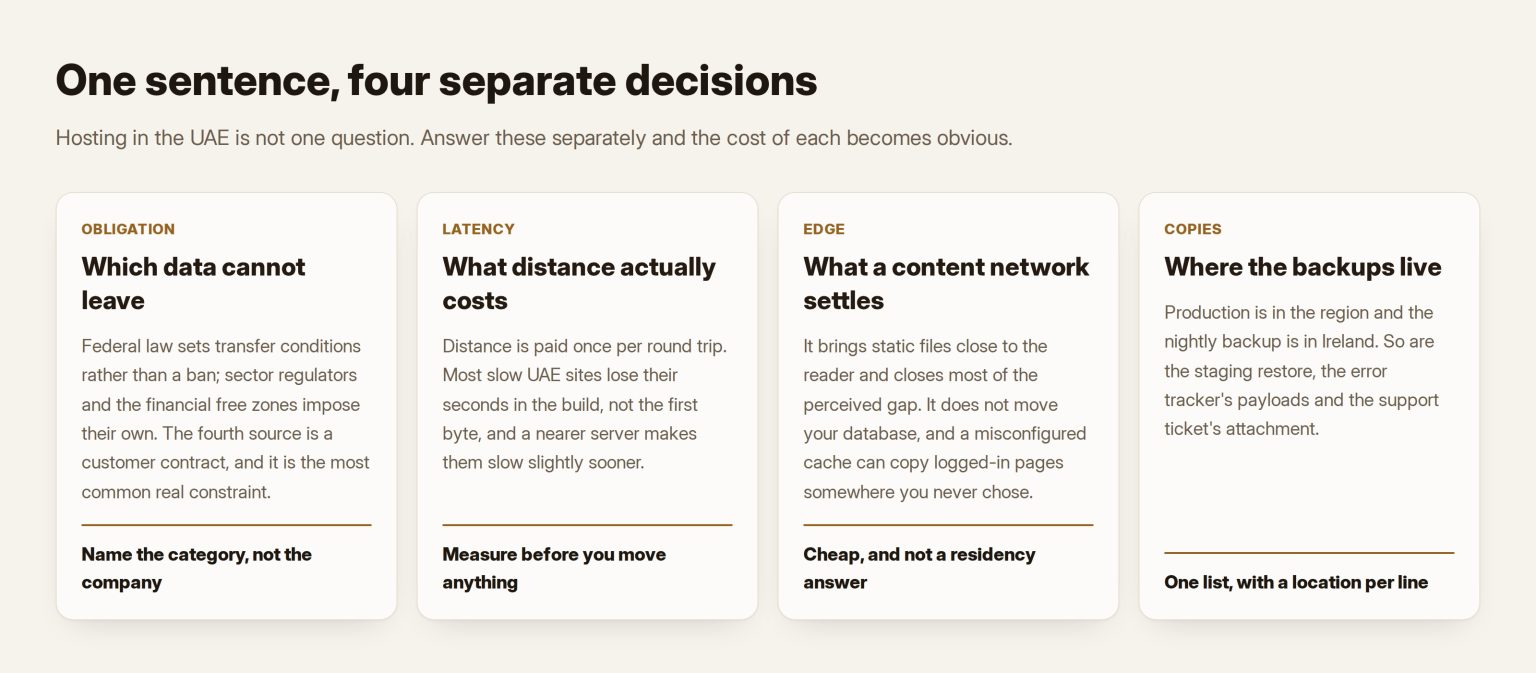
There are three separate sources of such an obligation, and they are routinely confused. Federal data protection law, summarised on the UAE government’s own overview, sets conditions on transferring personal data abroad rather than a blanket ban. Sector regulators impose stricter rules on particular industries, most visibly in health and financial services. And the free zones with their own legal frameworks operate their own regimes, which is why a DIFC or ADGM entity cannot simply inherit a mainland answer.
Then there is the fourth source, which is not law at all: a clause in a customer contract. In practice this is the most common real constraint I find, and it binds you whatever the statute says.
So the legal answer is rarely “everything must be in the UAE”. It is usually “this category must be, that category has conditions, the rest is a preference”. Getting that written down converts an argument into a specification.
The speed question is about distance and about the build
Distance costs time. A request to a server in Europe and back takes longer than one to a server in the region, and that cost is paid once per round trip — so a page that makes forty requests pays it forty times.
But the first byte is rarely where a slow UAE site loses its seconds. It is usually the build: uncompressed images, a page that renders nothing until a large script has loaded, a plugin doing database work on every view. Moving that same site to a nearer server makes it a slow site that is slow slightly sooner. Time to first byte is the part hosting changes, and it is one metric among several.
The test is cheap: measure time to first byte from the UAE, then measure how long the page takes to become usable. If the first number is small and the second is large, hosting is not your problem and a migration will not fix it — which is the diagnosis I set out separately.
What a content network does, and what it does not
A content delivery network keeps copies of your static files close to the reader, so images, stylesheets and scripts arrive from a nearby city while your application stays where it is. For most brochure and catalogue sites this closes most of the perceived distance gap at a fraction of the cost of moving anything.
What it does not do is move your database, and it does not satisfy a residency obligation by itself. Worse, a poorly configured one can create a new one: a cache copies pages to locations you did not choose, and if a logged-in page with personal data gets cached, your data is now in places your policy never contemplated. Cache behaviour is configuration, not magic, and it is worth reading what yours is set to do with anything behind a login.
The catch that surprises people: not every service exists in every region
Both major cloud providers have UAE regions, and both publish exactly which services are available where. Microsoft’s products by region table and Amazon’s regional services list are the documents to check before anybody commits to an architecture.
This bites hardest on AI features. A managed model that exists in a European or US region may not be offered locally, and the workarounds are all unattractive: run in a nearer region and accept that the data leaves, wait for availability, or build something yourself. If a residency requirement and an AI feature are both hard requirements, that tension has to be surfaced in week one rather than discovered in month four.
It is also worth knowing that the two questions can be answered separately for separate systems. Your website can sit anywhere while the system holding customer records sits where the obligation requires. Treating “our hosting” as one decision for everything is what makes the choice feel expensive.
Backups leave the country when nobody is looking
This is the gap I find most often, and it survives every audit that only looks at production. The application sits in the region, the database sits in the region, and the nightly backup is written to a bucket in Ireland because that is what the default was when somebody set it up three years ago.
The same applies to the copies nobody calls backups: the staging environment restored from live data, the export a developer took to debug something, the monitoring tool holding request payloads, the error tracker capturing form contents, and the support system where a customer’s document ends up as an attachment. Each of those is a place your data lives, and each has its own location.
Write the list once, with a location against every entry. If a residency obligation applies, it applies to all of them, and the backup is the one that will be asked about first when anybody senior is asking. It is also the list that makes the data protection questions answerable in an afternoon rather than a fortnight.
What UAE hosting genuinely costs you
Regional capacity is not the cheapest capacity, and the gap is usually larger than the headline hourly price suggests once you account for the managed services you would have used elsewhere and now have to run yourself.
There is also an operational cost that nobody quotes: fewer local specialists for any given stack, and support hours that may not align with your working week. That is not a reason against it. It is a line in the comparison that gets omitted, and it belongs beside the licence and platform costs in the same way the ongoing work does in any decision with a maintenance tail.
Moving, and the two ways it goes wrong
The first is doing it during a complaint. A migration under pressure skips the rehearsal, and the rehearsal is where you learn that the mail was on the same box, that a cron job nobody documented feeds a report somebody reads on Sundays, or that an integration authorises by IP address and yours is about to change.
The second is moving everything at once. Applications, databases and mail have different failure modes and different audiences; moving them together means an incident has three possible causes and no clean rollback. Move one, watch it for a week, move the next.
Either way, lower the record time-to-live before the switch, keep the old environment running until traffic has genuinely stopped arriving there, and rehearse the rollback rather than assuming it. A migration you cannot reverse is not a migration; it is a leap.
The decision, in four lines
If a specific obligation names data residency, host that system in the UAE and design around what the region offers. If no obligation does, host wherever your team can operate well and put a content network in front of it. If the complaint is speed, measure before you move. And if the requirement came from a contract rather than a statute, negotiate it knowingly rather than complying blindly, because it may be costing you an architecture for no protection anybody wanted.
Where an obligation and a capability genuinely conflict, the answer is usually architectural rather than geographic: split the system, keep the restricted data in the region, and let the parts that do not touch it run where the capability exists. Tothiq builds that kind of split across the GCC.
What to write down before anybody quotes
One page. The categories of data you hold, which of them carry a residency or transfer condition and who imposed it, where each system sits today, what the measured time to first byte is from the UAE, and which cloud services your architecture depends on plus whether they exist in the region you are considering.
That page makes three quotations comparable. Without it, every supplier answers a slightly different question and the cheapest one usually answered the easiest, which is the same problem as reading any system you did not build.
Frequently asked questions
Does hosting in the UAE help our Google rankings here?
Server location is one weak signal among many and it is not what decides local visibility. What matters far more is that the site is fast to become usable, that it is genuinely about the market you serve, and that the local business signals line up. Choose hosting for latency and obligations, not for rankings.
Our customer contract says data must stay in the UAE. Is that the same as the law requiring it?
No, but it binds you just as tightly, and it is the more common constraint in practice. Treat it as a requirement, cost it honestly, and if it is disproportionate raise it at renewal with a clear explanation of what it prevents. Many such clauses were copied from a template and nobody on either side has ever examined them.
Can we keep the website abroad and only the database in the UAE?
Often yes, and it is a sensible pattern where the obligation attaches to records rather than to pages. The cost is the distance between the application and its database, which can be worse than the original problem if every page view makes several queries. It is a design decision to take deliberately, not a compromise to fall into.
Is a content delivery network enough on its own?
For a brochure or catalogue site with no logged-in area, usually yes — it removes most of the perceived distance without moving anything. For an application where every page is personalised, it helps much less, because those pages cannot be cached at the edge in the same way. And it never answers a residency question by itself.
How do we test this before committing?
Measure the current site from the UAE, then stand up a copy in the region you are considering and measure the same pages. A day of work and a small bill gives you a real number instead of a vendor’s claim, and it will occasionally show that the difference is not worth the migration at all.