The question arrives as a yes or no. Do we need an Arabic version of the site? And it is answered by whoever is loudest in the meeting, because nobody has framed it as what it actually is: which pages exist in Arabic, who writes and maintains them, and what that costs every year for as long as the site is alive.
Answered that way it becomes a manageable decision with a number attached, and it usually produces a smaller and better Arabic site than the all-or-nothing version.
Where it is not a choice
Start with the part that is not optional, because it changes the shape of everything else. Arabic is the official language of the United Arab Emirates, as the government’s own fact sheet states, and consumer protection law reaches into commercial documents directly: the government’s guidance says the invoice must be in Arabic, and the provider may add any other language.
The executive regulations go further for anyone selling online. They require an e-commerce seller to state a product’s components and standards in its original language in addition to Arabic, and require Arabic-language brochures.
So for a company that sells goods online here, some Arabic is a legal obligation rather than a marketing choice, and it lands on product information and documents rather than on your homepage. That is worth knowing before the conversation turns into whether Arabic will bring more traffic.
Three levels, not two
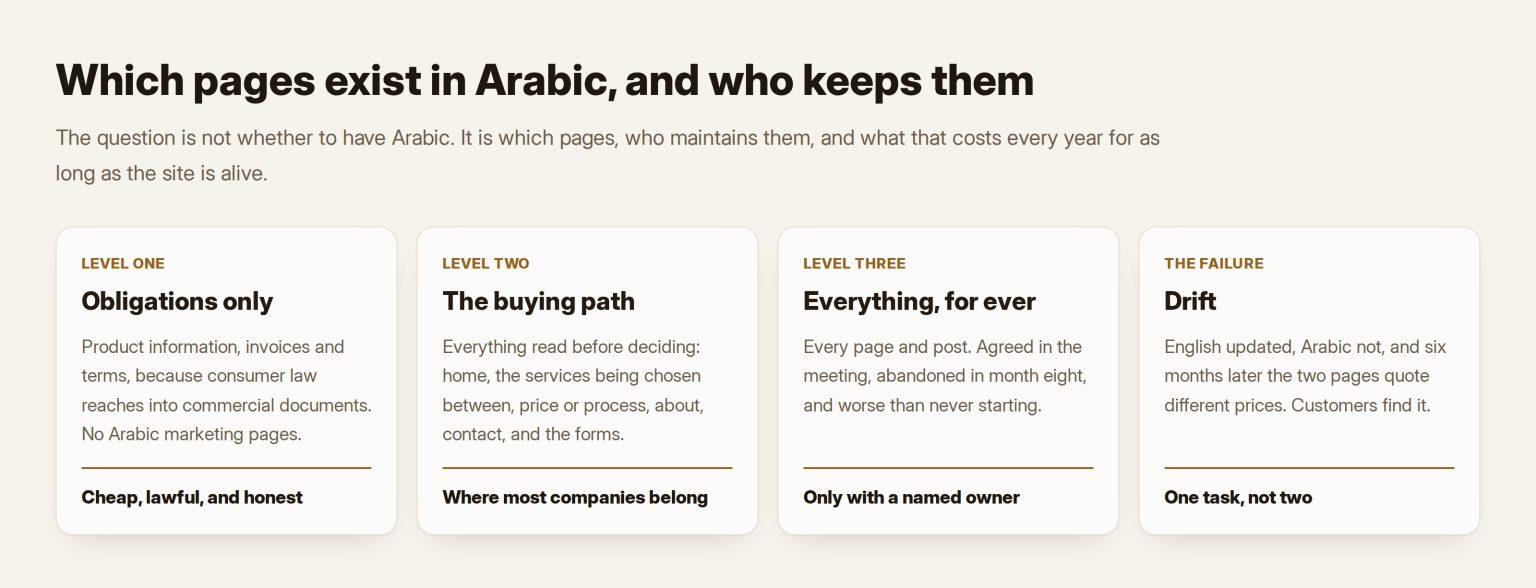
The debate is usually framed as Arabic site or no Arabic site. There are three positions, and the middle one is where most companies belong.
Level one: obligations only. Product information, invoices, terms, and whatever your sector requires. No Arabic marketing pages. Cheap, lawful, and honest about what it is.
Level two: the buying path. Everything a customer reads before deciding — home, the services or products they are choosing between, pricing or process, about, contact, and the forms. Not the blog, not the careers page, not the archive.
Level three: everything. Every page, every post, for ever. This is the level that gets agreed in the meeting and abandoned in month eight, and the abandonment is worse than never having started, because a half-translated site tells the visitor which language you actually care about.
Choosing which pages, from evidence
Do not decide this from a principle. Pull the last two hundred enquiries and count how many arrived in Arabic. Look at your analytics for browser language. Look at Search Console for Arabic queries. Three numbers, an afternoon, and the answer stops being an opinion.
Then apply one rule: a page gets an Arabic version if a customer would read it before deciding to buy. Everything else can wait, and most of it waits for ever without anyone minding.
The most common mistake here is translating the pages that were easiest to translate rather than the ones that matter, which produces an Arabic site consisting of the about page and three old blog posts.
The second most common is forgetting the parts that are not pages. The forms, the confirmation emails, the error messages, the invoice, the delivery notification. A visitor who reads a full Arabic page and then receives an English confirmation has learned exactly how far the effort went.
What it costs to keep
The build cost is the small half. The running cost is what nobody budgets.
Every price change, every new service, every policy update, every product added, and every campaign now happens twice. Whoever owns the site has to know that the Arabic version exists and remember to update it, and that person changes every couple of years.
So the honest annual number has three parts: translation or writing for whatever changes, a review by somebody who reads Arabic properly, and the extra time on every content task for ever. For a small business site that is not large. For a store with a moving catalogue it is a real recurring line, and it should appear in the budget rather than being absorbed by whoever notices.
What you should not do to avoid that cost is machine-translate everything and leave it. Google’s spam policies name scaled content abuse explicitly, including automated transformations such as translating with no added value. Machine translation as a first draft that a person edits is fine and normal. Machine translation as the finished product is a risk to the site and an insult to the reader.
The mechanics that decide whether it survives
Three technical decisions, taken once, determine whether the Arabic half stays healthy.
Give each language its own URL. Google’s guidance for multi-regional and multilingual sites is explicit that distinct URLs per language are required and that URL parameters such as a query string are not recommended. A site that swaps language without changing the address cannot be indexed in both.
Connect the pairs properly, and note the catch: annotations must point both ways, because if two pages do not both point at each other, the tags are ignored. One-directional linking is the most common bilingual defect on this market’s sites, and it silently produces no benefit at all.
And declare the language and direction on the page itself. The W3C’s guidance is to always set the default language on the html element and to also use the direction attribute when dealing with bidirectional text such as Arabic. That is a one-line requirement that fixes a category of rendering problems before they appear.
None of this is about how the Arabic looks or reads, which is a separate craft and a separate post — the design questions an Arabic-second site gets wrong. This is the plumbing that decides whether the Arabic pages are findable at all.
The failure mode, and how to prevent it
Drift. The English page is updated with a new price, the Arabic one is not, and six months later the two pages describe different offers. Customers find it, and it costs you the trust that having Arabic was supposed to earn.
Two cheap preventions. Make the languages one task rather than two: the job is not finished until both are done, enforced by whoever approves the work. And review the Arabic pages once a quarter against their English counterparts, which takes an hour and is the most valuable hour in this whole exercise.
If neither of those will happen, choose level one and be at peace with it. A small, accurate, well-maintained Arabic presence beats a large decaying one, and it is a decision you can revisit when there is somebody to own it. Where the site is a serious commercial asset rather than a brochure, this belongs in the brief before the build — part of the web work — and it is worth remembering that being read in Arabic and being cited in Arabic are now different problems, which is the distinction in ranking and being recommended. And whichever language the enquiry arrives in, it still has to reach a person.
If the answer is yes, building it bilingual from the start costs less than retrofitting it, and that is how my company builds: website design and development at Tothiq.
Frequently asked questions
Most of our customers are expatriates who read English. Do we still need it?
The legal obligations on product information and invoices do not depend on your customer mix, so those apply regardless. Beyond that, count rather than assume: pull the enquiries and the analytics and see what actually arrives. Many companies find their website audience is more English than their messaging channels are, which points to level one plus Arabic on the buying path rather than a full second site.
Can we start with a translation plugin and improve it later?
You can, with one condition: publish only what a person has read and corrected. Use the plugin to generate drafts, edit them properly, and leave the rest unpublished. Automatically translating an entire site and publishing it is the specific pattern search engines target, and it also produces the phrasing that tells an Arabic reader you did not think they were worth a person’s time.
Should the Arabic be a separate site or part of the same one?
The same site with distinct URLs per language, in almost every case. Two separate sites doubles the hosting, the maintenance and the chance of drift, and it splits whatever reputation the domain has earned. Separate sites make sense when the two audiences need genuinely different content rather than the same content in two languages, which is rarer than it sounds.
Which language should be the default?
Whichever most of your buyers use, and it does not have to be the language the company works in internally. What matters more than the choice is that the other language is one obvious click away, that the switch keeps the visitor on the equivalent page rather than dropping them on the homepage, and that the choice is remembered. That last detail is missing from most bilingual sites here.
How much does the ongoing work really amount to?
Estimate it from your own change rate rather than from a rule of thumb. Count how many pages you changed in the last twelve months and how many products or prices moved. That count, times the effort of doing each one twice, is your annual figure. For most business sites it is a few days a year; for an active store it is materially more, and knowing which one you are is the point of the exercise.