For a UAE online store, Oman looks like the nearest export market in the Gulf, and it is. A parcel can leave Dubai in the morning and cross by road the same day. But a store set up for the dirham meets three changes at that border at once: a rial with three decimal places, a debit card network your gateway may not reach, and import tax that someone has to pay before the parcel is handed over.
This is the UAE side of a series on selling into each GCC country. The earlier post on Jaywan cards covered the UAE’s own domestic scheme. Oman is a different argument, because here the store is the foreigner, and the border is a road rather than an airport.
The rial has three decimals, and the dirham has two
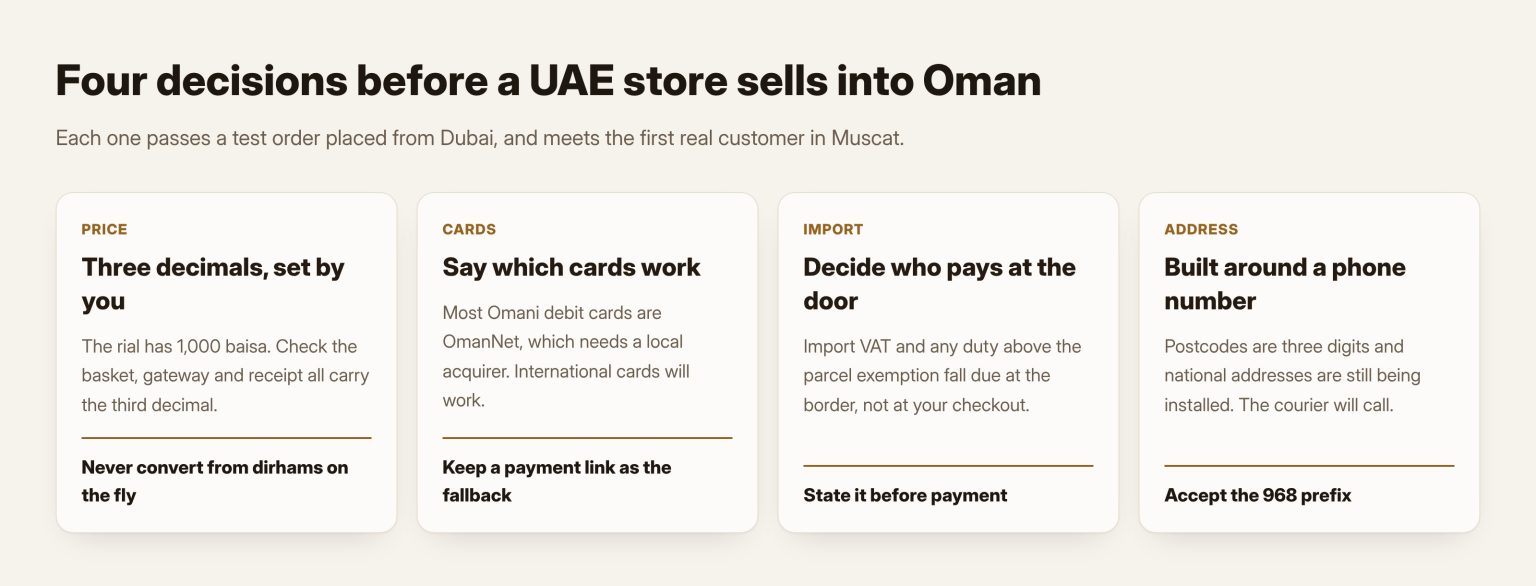
The Omani rial is divided into 1,000 baisa, so prices carry three decimal places. A UAE store built around two-decimal dirham prices can show 12.5 where an Omani customer expects 12.500, and different parts of the stack can round the third decimal differently: the product page, the basket, the gateway and the invoice.
Set Omani prices yourself rather than converting on the fly, and check that every system in the chain accepts three decimals before launch. Then place a test order and compare the total on the basket, the payment page, the bank statement and the receipt. A mismatch of a few baisa looks trivial and produces exactly the kind of message that makes a customer distrust the whole order.
OmanNet is the card most Omanis carry
Debit cards issued in Oman carry the OmanNet brand, the national network provided by the Central Bank of Oman. Checkout.com’s page on OmanNet puts their share at about 95 percent of cards in the country, processes them in rials only, and lists a direct agreement with a local acquirer as a requirement.
For a UAE store without an Omani entity or acquirer, that means the customer’s most likely card may not work at your checkout. Visa and Mastercard credit cards and co-branded debit cards will. Apple Pay, which launched in Oman in 2024 with several local banks, works only where the card inside it is one your gateway accepts.
The practical response is the same as for any domestic scheme you cannot reach: say which cards are accepted on the product page, not at the last step; keep a payment link to send when a card fails; and read your declines by country for the first month. If Omani declines are high, it is the card network, not the site.
The import tax is the customer’s, unless you decide otherwise
Oman has charged 5 percent VAT since April 2021. For goods shipped into Oman from outside, the Oman Tax Authority’s e-commerce guide, summarised by PwC, places the foreign seller outside Oman VAT and applies import VAT instead, recoverable only by the importer of record. Selling from a warehouse inside Oman is different and needs registration.
Customs changed in 2026 as well. Since 2 August, online shopping parcels for personal use are exempt from duty up to RO 100, under amendments made by Sultani Decree No. 28/2026, as LexisNexis summarised. That threshold should shape how you present larger orders.
The decision for the store is who pays at the door. Either the customer pays the import charges on delivery, which you state plainly before payment, or you collect an estimate at checkout and arrange for the courier to clear it. What does not work is saying nothing and letting the courier ask for money the customer did not expect. That is how parcels come back.
The border is a road, and the paperwork rides with it
Oman and the UAE share several official land crossings, including Hatta and Al Wajajah, Hilli near Al Ain, and Khatmat Malaha. Courier services offer land routes from the UAE, and customs clearance still needs a commercial invoice, a packing list and a proper description of each item.
Describe goods properly on the invoice, with a real value and a real item name. “Gift” or “accessories” slows clearance, and an undervalued parcel can be held. Both reach the customer as an unexplained delay. The land route is the advantage over every other GCC market for a UAE store, so protect it: ask your courier which crossing they use and how long clearance usually takes, and promise a delivery range you can keep, not their best day.
Show the delivery cost and time to Oman on the product page, not only at checkout. A customer who discovers at the last step that delivery costs more than they assumed leaves, and a store that hides it until then looks as though it hoped they would not notice.
Omani addresses are still being written
Oman Post uses three-digit postcodes, and its addressing standard is built around post office boxes. A national addressing project is under way, with street and building plates being installed region by region and a target of a unified address for every building by 2028.
Until then, the delivery detail that matters most is the phone number. Make the mobile number required, ask for the area and a landmark, and allow a location pin to be shared. A form copied from a UAE checkout, with emirate and community fields, will collect the wrong information and leave the courier to telephone and guess.
Check the phone field itself. Many UAE checkouts validate the number as a UAE number, with the 971 prefix and a fixed length, and either reject an Omani number with its 968 prefix and eight digits, or accept it after adding the UAE prefix. The result is an order whose owner the courier cannot call. Let the country code follow the shipping address, and test with a real Omani number before launch. The same validation fault is one of the ways contact forms lose UAE enquiries.
Arabic on the invoice, and returns that cross back
Oman’s consumer protection rules require invoices in Arabic, with other languages allowed alongside, and the country’s e-commerce rules ask stores to describe products accurately and state delivery and return terms clearly. Those rules are written for providers in Oman or with a representative there, but a bilingual receipt and a clear returns page cost a UAE store little and answer questions before they are asked.
Decide returns before launch: which items you accept back from Oman, who pays the return trip across the border, and whether the refund waits for the item to arrive. A refund to an international card reaches the customer in rials after their bank converts it, which rarely matches to the baisa, so say so in the policy.
Cash on delivery and the payment link
Cash still carries a real share of everyday spending in Oman, and some couriers offer cash on delivery across the border. It removes the card problem entirely, which is why stores reach for it. It also moves the risk of a refused parcel onto you, with a return trip across the border on top, and it leaves the cash with the courier until they settle.
If you offer it, start with lower-value orders and watch the refusal rate for a month before widening it. A payment link sent by WhatsApp after the order is placed is often the better middle route: the customer confirms the order in conversation, pays with whatever card works, and the parcel leaves already paid.
Test it from Oman, not from Dubai
An order placed from your own office proves almost nothing here. Your card is a UAE card, your phone has a UAE number, and your address form fills itself in from habit. Every fault in this post passes that test.
Ask someone in Oman to place two real orders: one with a credit card, one with their everyday debit card. Ask them to send a screenshot of every error, and to tell you what the courier said at the door. Two orders and a short conversation will tell you more than a week of internal testing, and they cost less than the first refused parcel.
The order I would do it in
First, read your own data: Omani visitors, abandoned baskets and failed payments you already have. Second, add Oman as a destination with rial prices to three decimals, accepted cards stated early, the import charge position written before payment, and an address form built around a phone number. Third, have someone in Oman place real orders on a real phone, one with a credit card and one with a debit card, before any advertising there.
An Omani acquirer, and OmanNet with it, starts to make sense only when Oman is a steady share of orders. For the platform question underneath all of this, Shopify or WooCommerce for UAE payments and getting the merchant account approved come first. Where the store needs building or extending for Oman, Tothiq AI Services and Solutions builds WooCommerce stores that sell across the GCC.
Frequently asked questions
Can a UAE store accept OmanNet debit cards?
Generally not without an Omani acquiring agreement, which payment providers list as a requirement. Until then, rely on Visa, Mastercard and Apple Pay with cards your gateway accepts.
Do we have to register for VAT in Oman?
Not for goods shipped into Oman from the UAE, under the Tax Authority’s e-commerce guidance; import VAT applies at the border instead. Holding stock in Oman changes that. Confirm your own position with a tax adviser.
Who pays the import charges on an Omani order?
You decide, and you say so before payment. Either the customer pays on delivery or you collect it at checkout. Saying nothing is what gets parcels refused.
Should prices for Oman be in rials or dirhams?
Rials, three decimals, set by you rather than converted live. Make sure every part of the store and the gateway handles the third decimal before launch.
How long does delivery from Dubai to Muscat take?
It depends on the courier and the crossing they use. Ask them for their usual clearance time, add a margin, and promise that range rather than the fastest case.