Every comparison you can find between these two platforms is a feature comparison. Themes, apps, inventory, reporting, how easy the admin is. All of it accurate, and almost none of it decisive, because for a UAE merchant the choice is settled by something the comparisons barely mention: which payment methods you can actually offer, and what each one does to your margin.
Get that right and either platform will serve you. Get it wrong and you will have built a shop that a good share of your customers cannot or will not pay on, which is the expensive kind of mistake because it is invisible until the store is live.
Start from the payment methods, not the platform
Before comparing anything, write down how you expect to be paid, in the proportions you actually expect. Cards. Cash on delivery. A local wallet. Bank transfer for larger business orders. Instalments.
That list is your requirement. Everything else follows from it, because a platform is only as good as the payment methods it lets you present at the moment somebody decides to buy.
Most merchants have never written it down, and the act of writing it produces the first useful argument of the project. Somebody says cards will be ninety per cent; somebody else who answers the phone says half the callers ask whether they can pay on delivery. Both are describing real evidence, and the gap between them is the thing your platform choice has to survive.
What Shopify actually offers a UAE merchant
The common belief is that Shopify’s own payment processing is unavailable here. That is now out of date and the accurate position is more nuanced. Shopify’s documentation does list the United Arab Emirates among the countries where its own processing is offered, and the country page qualifies it precisely: Shopify Payments in the UAE is in early access and available only to certain merchants.
So the first question for Shopify is a factual one about your own account rather than about the platform: are you eligible, today, for their processing. Ask before you build, because the answer changes the economics.
If you are not, you use one of the alternatives. Shopify supports over a hundred third-party card providers, and applies a third-party transaction fee on all of them. That fee is charged by Shopify on top of whatever the provider charges you. It is a small percentage, and on a store doing real volume it is not a rounding error, and it is the single most common surprise in the first invoice after launch.
What WooCommerce actually offers
WooCommerce takes the opposite shape. It is open source, published on the WordPress plugin directory with more than seven million active installations and an explicit position that your data belongs to you, and it charges nothing for using another company’s payment provider.
Any provider can be connected because a gateway is simply a plugin: the developer documentation describes gateways as separate plugins that extend a payment gateway class and register themselves through a filter. Practically, that means if a UAE provider exists and has built a plugin, you can use it, and if they have not, one can be built.
The cost of that freedom is that you own the whole thing: the hosting, the updates, the security, the backups, and the compliance work when the payment provider asks about your setup. That is a real recurring cost and it is usually underestimated by exactly the people who chose WooCommerce to save money.
The regulated layer both sit on
Neither platform is your payment provider. In the UAE that role is licensed and defined: the Central Bank’s Retail Payment Services and Card Schemes Regulation sets out licence categories for providers of retail payment services. Your gateway, your acquirer and your wallet all sit inside that framework.
The practical consequence is that a chunk of your launch timeline belongs to somebody else and is unaffected by which platform you picked. Card authentication is the same on both, too: lower-risk transactions pass without friction and higher-risk ones trigger a challenge, usually a one-time passcode from the customer’s bank. Nobody escapes that screen by choosing a different shop platform, and nobody controls it either.
What this means for the comparison is that a whole layer of your customer’s experience is identical whichever way you go. The differences that remain are the ones above: which providers you can present, what each transaction costs you, and who is responsible when something needs fixing at eleven at night.
Cash on delivery is a product decision
In this market it is not a minor payment option, and both platforms handle it, differently.
On Shopify it is a manual method: the documentation is clear that cash on delivery is a manual payment method, and the order stays unpaid until you mark it paid. That works, and it means your order status and your money are two separate truths until somebody reconciles them.
On WooCommerce it is a built-in gateway and behaves the same way in practice.
The real decision is not technical. It is whether you accept the failed-delivery rate, the cash handling, and the customers who change their mind at the door, in exchange for the orders you would otherwise never receive. Decide that with a number attached, offer both at launch, and watch the ratio: it is also the most honest measurement you will get of whether your card checkout is any good.
The way I would actually decide
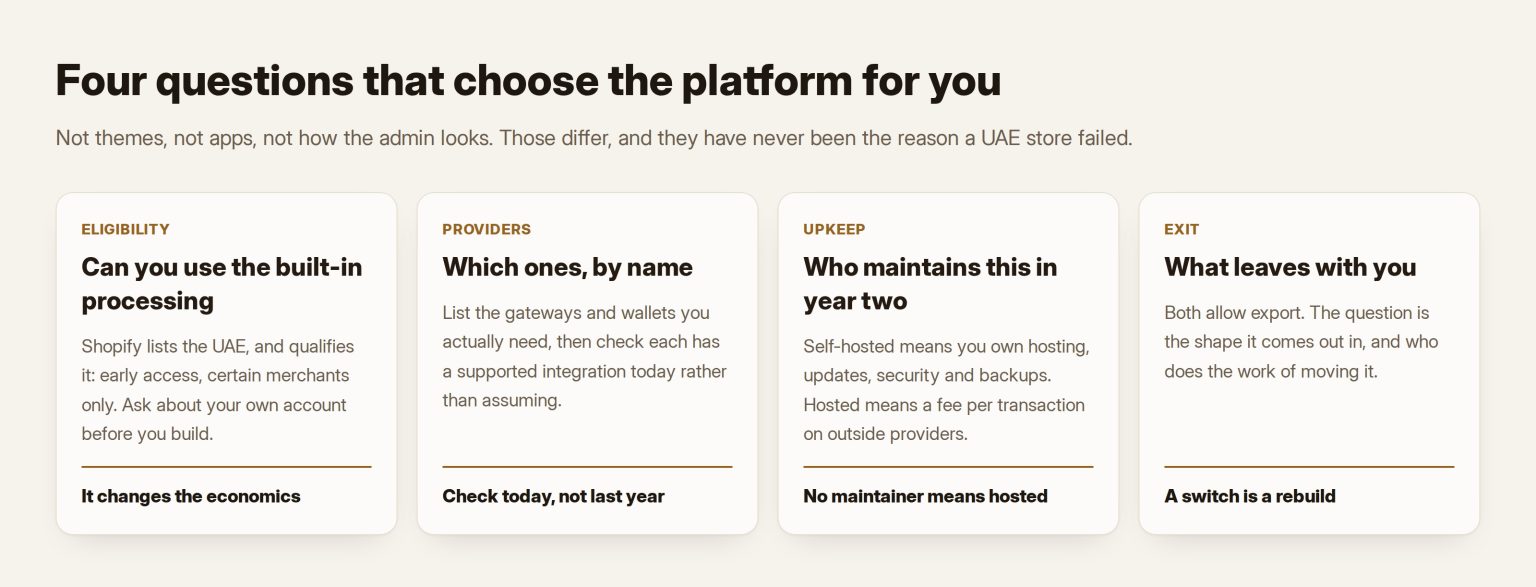
Answer four questions, in this order, and the platform chooses itself. None of them is about themes, apps or how the admin looks, and that is deliberate: those differ, they matter to whoever runs the store daily, and they have never once been the reason a UAE store failed.
Are you eligible for Shopify’s own processing today? If yes, and card payments dominate your expected mix, Shopify becomes markedly more attractive because the extra transaction fee disappears.
Which specific providers do you need, by name? Check each one has a supported integration on the platform you are considering, and check it today rather than assuming.
Who maintains this in eighteen months? If the answer is nobody, choose the hosted option and pay the fee. A self-hosted store with no maintainer is not cheaper, it is deferred.
What happens to your data if you leave? Both allow export; the question is what shape it comes out in and who does the work.
That last question is the one that separates a platform decision from a purchase, and it is the same instinct that runs through the technical due diligence I do on systems people have inherited. Getting it wrong is a textbook case of a technology decision paid for twice. And whichever platform wins, the store still has to be reachable and answerable, which is where the enquiry side quietly loses people and where the build itself earns its cost.
My company builds on both and the arithmetic above is how it decides between them, across the GCC: WooCommerce stores or Shopify stores at Tothiq.
Frequently asked questions
Which is cheaper overall?
At low volume the hosted option usually is, once you price hosting, maintenance and the developer hours that a self-hosted store consumes. As volume rises, the subscription plus the extra transaction fee grows with your revenue while hosting does not, and the arithmetic reverses at some point specific to your margin. Model both at your expected year-two volume rather than at today’s, because that is the year the decision actually bites.
Can we switch later if we choose wrong?
Products, customers and orders move with effort; what does not move cleanly is everything built around them — the theme, the apps, the automations, and the URLs, which matter for search. Budget a switch as a rebuild rather than a migration. That is a reason to decide carefully now, not a reason to treat the first choice as permanent, and it is why the export question belongs in the evaluation.
Our developer only knows one of them. Does that settle it?
It is a genuine input and a poor sole reason. Familiarity lowers cost and risk now, and it can also mean you are choosing the platform your supplier prefers to sell rather than the one your customers need to pay on. Run the four questions first. If the answer matches your developer’s preference, you have both a good decision and a cheap one, which is the ideal outcome.
Do we need a free zone or mainland licence for either?
The platform does not care; your payment provider does, and so does your bank. The entity type affects which providers will onboard you and what documents they ask for, and it is worth resolving before you commission a store rather than after. That approval process runs on its own timeline and is the most common reason a finished store sits unable to take money.
Should we support Arabic from day one?
Decide it deliberately rather than by default in either direction. Adding a second language to a store is not only translation: it is product names, categories, emails, error messages, invoices and support. Both platforms can do it, and both make it more expensive to add later than to plan for now. If most of your expected buyers read Arabic first, treat it as part of the build rather than a phase two that never arrives.