For twenty years, being found meant ranking. Someone typed a query, saw ten links, clicked one, and you could measure the whole thing. That still happens and it still matters.
What is new is that a growing share of buyers never see that page. They ask an assistant, get an answer assembled from sources the model decided to trust, and act on it. No ten blue links, often no click at all. If you are not among the sources, you are not in the conversation, however well you rank.
These are two different problems. They overlap, but they are not won the same way, and a supplier who talks about one while quietly ignoring the other is selling you half the work. Both are what my search and AI visibility work covers.
What has not changed
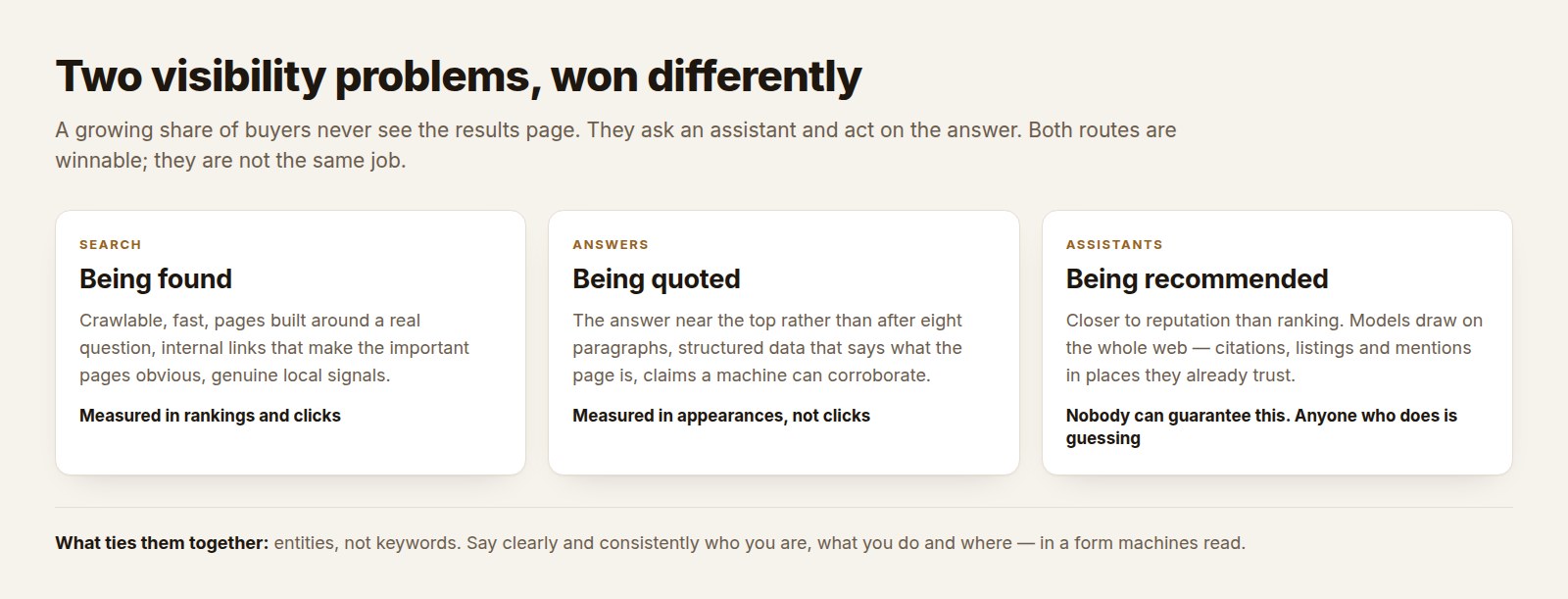
Classic search still rewards the same things: a site that can be crawled quickly, pages built around what a person is actually trying to find out, internal linking that makes the important pages obviously important, and — locally — an accurate business profile with consistent details.
One local caveat worth stating plainly: putting “Dubai” in a heading is not local relevance. Genuine local signals are addresses, real regional references, work that demonstrably happened here, and consistency across every place your business is listed.
What is different about being quoted
Getting lifted into an answer box rewards a specific shape of content: the answer near the top rather than buried after eight paragraphs of preamble, structured data that states plainly what the page is, and claims a machine can corroborate somewhere other than your own site.
The preamble habit is the single most common problem I see. A page that opens with three paragraphs of throat-clearing before answering the question will lose to a page that answers it in the first sentence, even if the first page is better written.
What is different about being recommended
Being named by an assistant is closer to reputation than to ranking. Models draw on what they can find about you across the whole web, not just on your own site. So the work splits in two.
On your site: clear entity information, consistent naming, and structured data that connects you to your subject rather than just describing a page. Off it: being cited, listed and mentioned in the places the model already trusts — trade bodies, real directories, press, other people’s writing.
Nobody can guarantee an assistant will name you, and anyone promising that is guessing. What you can do is make yourself the easiest candidate to describe accurately.
Entities, not keywords
Both search engines and language models increasingly reason about things rather than strings: this company, this person, this service, in this place. Getting that right means saying clearly and consistently who you are, what you do and where — in a form machines read.
It is unglamorous work: structured data (the vocabulary is at schema.org), matching profiles, the same facts stated identically everywhere they appear. It is also the highest-leverage work on most sites I audit, because so few businesses have bothered.
The bilingual part, which almost everyone gets wrong
Arabic and English are separate search markets with different competition, different phrasing and different intent. A page translated word for word usually targets nothing in either language, because nobody searches in translationese.
Arabic search deserves its own keyword research and often its own pages, not a mirror of the English ones. In a market where a large share of buyers search in Arabic, treating it as a translation layer is leaving the easier half of the opportunity on the table — and it shows in the design as much as in the rankings, which is the subject of Arabic-second always shows.
Why buying this as a service usually disappoints
A market has already grown around this, and most of what it sells is the old service with a new label. The tell is what the proposal promises to change.
If the deliverable is more content, more keywords and a monthly report, you are buying the previous decade’s product. Nothing in that list makes an assistant more likely to name you, because assistants are not choosing between pages competing on a term. They are answering a question, and they reach for sources that are specific, attributable and corroborated somewhere other than your own website.
Which means the work that actually moves this is unglamorous and mostly not on your site at all. Being described consistently across the places that already mention you. Saying something concrete enough to be quoted without a caveat. Having a real answer to a question a buyer asks, written plainly, rather than a page optimised around the phrase they might type.
None of that produces a satisfying monthly chart, which is precisely why it is undersold.
The uncomfortable part about volume
The instinct when visibility drops is to publish more. It is the wrong instinct here, and it is expensive.
Thirty thin pages give an assistant thirty vague sources. One page that states something specific, dated and checkable gives it something it can quote with a name attached. The second is worth more than the first, and it is the opposite of what a content calendar rewards.
This is difficult for companies that have measured their marketing in output for years. Publishing less and better looks like doing less. The honest framing is that you are moving spend from volume to specificity, and the way you will know it worked is not traffic but whether you start hearing “I asked around and your name came up” from people you never saw in an analytics report.
Being recommended rather than merely ranked is a service my company sells: AI search visibility at Tothiq.
Frequently asked questions
Is search engine optimisation dead?
No, and the claim usually comes from someone selling the replacement. People still search, results still rank, and the structural work — clean URLs, fast pages, sensible internal linking, correct handling of two languages — is the same work it always was. What has changed is that ranking is no longer the only surface. Treating the new one as a reason to abandon the old one gets you neither.
Is there a structured data format that makes an assistant cite us?
There is no special markup that buys a citation, and anyone selling one is selling a story. Structured data helps a machine understand what a page is about and who it belongs to, which is worth doing properly. It does not function as a request to be quoted. The thing that makes you quotable is a passage that says something specific and stands on its own without the surrounding page.
How do we measure this if the assistants do not report traffic?
Partly with the tools that do report — Search Console for the search side, and Bing Webmaster Tools, which publishes an AI performance view covering citations. Beyond that the honest method is manual and repeatable: write down the ten questions a buyer would actually ask, put them to the assistants once a month, and record who gets named. It is unglamorous and it is the only measurement that reflects the thing you are trying to change.
How long does this take to show anything?
Longer than paid search and shorter than reputation. The structural work shows up in weeks. Being named by an assistant depends on corroboration accumulating in places you do not control, which is months rather than weeks and is not something a supplier can put a date on honestly. Anyone who gives you a firm timeline for a citation is describing something they cannot deliver.
Does any of this matter if we operate mainly in Arabic?
It matters more, not less. There is far less Arabic material for an assistant to draw on, so the bar for being the source it reaches for is lower than in English — but only if your Arabic exists as real, indexable content rather than a translation layer sitting on top of English pages. That distinction decides whether you are a candidate at all.
How to tell whether it is working
Rankings are a proxy and an increasingly weak one. Measure enquiries, calls, and qualified traffic. Separately, ask the assistants themselves — periodically put your own buying questions to them and see who gets named. If the answer is nobody in your category, that is an opening rather than a problem — the same one that makes unfinished AI projects so common. It is crude, it is not a dashboard, and it tells you more than a rankings screenshot that improves while the phone stays quiet.