A flexi-desk licence gives a UAE company a legal address. It does not give it a Google Business Profile. The two are judged by different rules, and a profile built on the first one is exposed to the second every time Google checks it.
This is about verification and eligibility only: whether Google will let the profile exist at all, and what to do when it will not. How a verified profile then ranks is a separate job.
The licence address and the Google address answer different questions
The address on a trade licence answers a regulator’s question: where is this company registered, and where can it be served notice? A flexi-desk answers it perfectly. It is a real address, in a real free zone, attached to a valid licence.
The address on a Business Profile answers a customer’s question: can I go there and be served? Google’s rules are written entirely around that second question, which is why a company can be fully compliant with its licensing authority and still be ineligible for a profile at the same address. Nobody told the founder, because the free zone was never asked the second question.
The gap is wider in the UAE than in most markets because flexi-desk and shared-desk licences are a normal, sensible way to start a company here. They keep the licence cost down while the business proves itself. Nothing about that choice is wrong. It only becomes a problem when the same address is typed into a Business Profile as though it were a shopfront.
What Google’s guidelines actually say
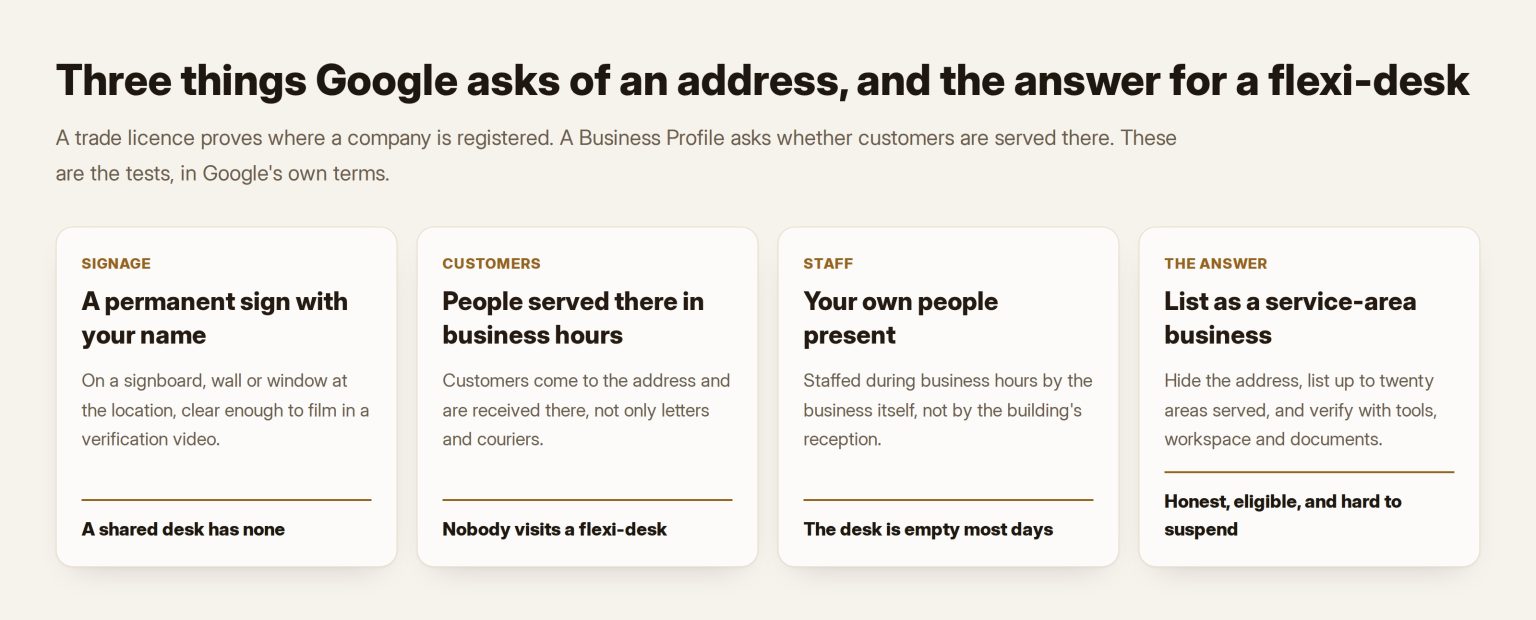
The wording is unusually direct. Google’s guidelines for representing your business state that a business which rents a physical mailing address but does not operate from it, a virtual office, is not eligible for a Business Profile at that location. Co-working space is allowed only if the office maintains clear signage, receives customers there during business hours, and is staffed during those hours by the business’s own people.
Read those three conditions against a typical flexi-desk: a shared desk, no sign, no customers, nobody there on most days. It fails all three. That is not a technicality Google might overlook. It is the case the guideline was written for.
The same page sets a rule that catches the workaround too: P.O. boxes and mailboxes at remote locations are not acceptable addresses. Swapping the desk for a mailbox service, or for the free zone’s own reception, does not change the answer, because none of them is where customers are served.
Why a valid licence does not rescue the profile
Founders often expect the licence to settle the argument, because it is an official document with the address printed on it. It settles the wrong argument. The licence proves the company exists and is registered at that address; it says nothing about whether customers are received there.
Google does ask for a licence in some situations, which reinforces the confusion. Its page on suspended profiles lists business registration, licences, tax certificates and utility bills as evidence for an appeal, and asks that the name and address on them match the profile. A flexi-desk licence can match the address and still lose the appeal, because the suspension was about eligibility, not identity.
That distinction also explains why some flexi-desk profiles survive for months and then disappear. Nothing changed on the company’s side. A routine review, a competitor’s report or an edit to the profile brought it back in front of the rules, and the rules had not moved.
Verification is chosen by Google, not by you
The verification page is clear that the methods are determined automatically and cannot be changed, and that they depend on the business type, public information, region and hours. Where video verification is offered, Google recommends it.
A video is where a flexi-desk is most exposed. Google’s video verification instructions ask a storefront to show its location, its name on a permanent sign, and proof of management, such as opening a storage room or using the point of sale. A camera pointed at a hot desk in a shared lounge is evidence against you. The temptation is to film a borrowed office instead, which turns an eligibility problem into a misrepresentation one.
The same page has a separate set of requirements for service-area businesses: landmarks around the business address, the tools or workspace you use, and proof that you run the business, which can include a permit or an invoice in the profile’s name. A consultant with a laptop, a licence and invoices can meet those honestly.
The route that works: a service-area profile, done properly
Most flexi-desk businesses are consultants, agencies, contractors and online services. They go to the customer, or work remotely; the customer never comes to them. Google has a category for exactly that. Its guidance on service-area and hybrid businesses says that if you do not serve customers at your address, you remove the address from the profile and set the areas you serve instead, up to twenty of them.
Two lines on that page matter for the UAE. A service-area business can only have one profile for the whole area it serves, so there is no profile per emirate. And a business without permanent on-site signage is not eligible as a storefront and should be listed as a service-area business. That sentence is the flexi-desk answer, written by Google.
The address is still where verification happens; it is simply not shown on the profile. That removes the misrepresentation, and it keeps the profile honest about how you actually work.
Set the hours to when someone answers the phone, not to the free zone’s opening hours, and link the website field to the page that describes the service rather than the home page. Both are small, and both are what a customer checks before calling.
What not to do while waiting
Do not borrow a friend’s shop. Do not list a relative’s villa. Do not create a second profile after a first one is suspended; the suspension page says plainly not to create a new profile for the same business while an appeal is under review. Each of these can end with the profile removed and a record that makes the next attempt harder.
Do not buy a “verified profile” either. The seller does not own the address, and you will not own the profile.
When a real office is worth the rent
Sometimes the honest answer is that the business does need a storefront. If customers genuinely come to you, to collect goods, to be seen by a practitioner or to sign in person, then a service-area profile misdescribes you and a real, signed, staffed location is the right investment. The cost of that office is a business decision; the profile follows from it, not the other way round.
The mistake is renting a small office only to get the profile. If nobody visits, the office fails the same test the flexi-desk did, a few months later and at a higher rent.
What carries the search in the meantime
A service-area profile still appears, still collects reviews and still shows a phone number and a website. What it does not do is rank you in a map pack for a street. For most flexi-desk businesses that was never the search that mattered. The searches that matter are for the service, and those are won on the website, as I set out in why a Dubai business ranks for its own name and nothing else, and increasingly in whether assistants mention you, which is a monthly test anyone can run.
The same logic applies to enquiries. A service-area profile sends people to your phone, your WhatsApp and your contact form rather than to a door, so those have to work every time. If the form is the weak point, the contact forms that lose UAE enquiries is where I would start.
The order I would do it in
First, answer the customer question honestly: do people come to you, yes or no. Second, if no, convert or create the profile as a service-area business, with the address hidden and the emirates you actually serve listed. Third, verify with whatever method Google offers, without borrowing anything. Fourth, fill the profile completely: services, hours when someone answers the phone, a website link to the right page. Fifth, put the effort you would have spent on an address into the website and into being worth mentioning.
This is part of the search visibility work I do in SEO, AEO and GEO in the UAE. Where a company wants the profile, the site and the content handled together, Tothiq’s search visibility service covers the GCC, and it is where I send the work when it is ongoing rather than a one-off review.
Frequently asked questions
Our free zone says the flexi-desk address is valid. Why does Google disagree?
Because they are answering different questions. The free zone confirms where the company is registered. Google asks whether customers are served at that address during business hours, by your own staff, with signage. A flexi-desk usually answers the first question yes and the second no.
Will a service-area profile hurt our visibility?
It will not rank you for searches tied to a street, which a flexi-desk business was not going to win honestly anyway. It still shows your services, reviews, phone and website, and it cannot be suspended for misrepresenting a location you do not operate from.
Can we have one profile per emirate?
Not as a service-area business. Google allows one profile for the whole area served, with up to twenty areas listed. Separate profiles need separate real locations, each meeting the storefront conditions on its own.
Our profile was suspended. Should we start a new one?
No. Google’s own page says not to create a new profile for the same business while an appeal is under review. Fix the cause first, usually by converting to a service-area profile, then appeal with documents whose name and address match the profile.
We are moving to a real office next year. What should we do now?
Run as a service-area business until the office is real, signed and staffed. Then add the address and let Google verify the new location. Adding a storefront you do not yet occupy is the fastest route to a suspension you will carry into the new office.