You search your company name. You are the first result, with the site links underneath, and everything looks healthy. Then somebody asks whether you appear for what you actually sell, and nobody knows, because nobody has looked.
Ranking for your own name is not evidence that search is working. It is close to automatic: you are the only site that uses that exact phrase in that exact way, and no competitor is trying to take it. The question worth answering is what happens for the searches performed by people who have never heard of you, and there is a ten-minute way to find out.
Separate branded from non-branded, in ten minutes
Open Google Search Console, go to the performance report, and add a query filter that excludes your company name and its common misspellings. What remains is your non-branded demand — every search from a stranger.
The tool supports this properly. Search Console’s help documents that custom regular-expression filters use RE2 syntax, match partially by default, and are case-insensitive unless told otherwise, which is exactly the mechanism for splitting the two groups apart.
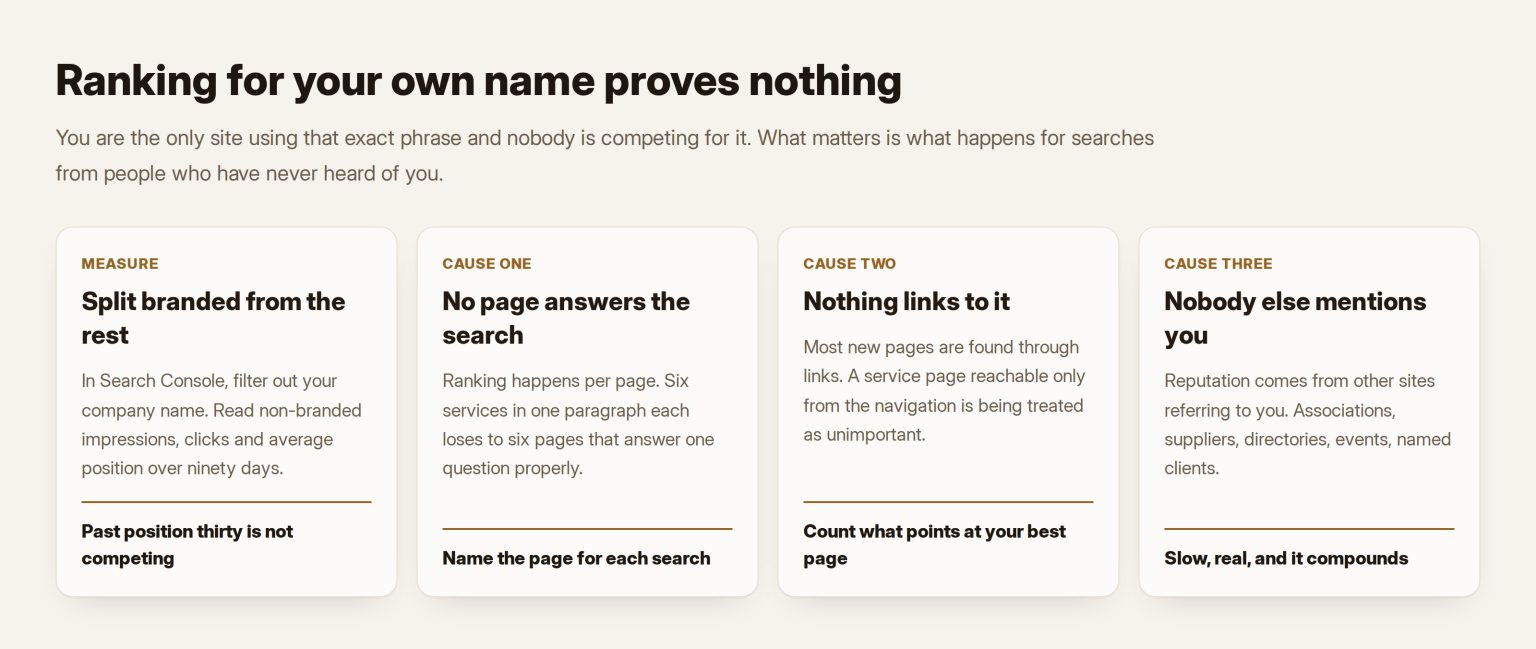
Then read three numbers: how many non-branded impressions in ninety days, how many clicks, and the average position. If the impressions are in the low hundreds and the position is past thirty, you are not competing at all. That is a diagnosis rather than a failure, and it is the honest starting point.
Reason one: there is no page about the thing they search for
This is the most common cause by a distance and the easiest to verify. Ranking happens per page against a query. If nobody has written a page that answers a particular question, there is nothing to rank, however good the company is.
Most business sites have a homepage, an about page, and a services page listing six services in a paragraph each. That is one page competing for six different intentions, and it loses to six pages that each answer one. Google’s ranking-systems overview confirms that link analysis and PageRank remain live core ranking systems alongside the content ones, which matters for the next two reasons.
There is a second version of the same problem, subtler and just as common: the page exists but is written in your language rather than theirs. A page headed integrated business solutions cannot rank for the thing the customer actually types, because those are different words about the same service. Read your service pages and ask, for each heading, whether a stranger would ever type that phrase.
The check takes twenty minutes. Write down the ten things a stranger would type to find a company like yours. For each, ask which single page on your site is the answer. Where you cannot name one, you have found the gap.
Do it in both languages, and do not assume the Arabic list is the English one translated. In this market it usually is not, and the difference tends to be the most useful thing the exercise produces.
Reason two: nothing on your own site points at those pages
Even where the page exists, it is often reachable only from the navigation, mentioned nowhere else, and treated by everything as the least important thing on the site. That is a signal, and it is being read.
Google is explicit that this is how discovery works: the starter guide states that the vast majority of new pages Google finds every day are through links, and the description of how search works has the same mechanism at its centre, with new URLs found when a link is extracted from a known page to a new one.
Internal links are the cheapest correction available and almost nobody makes them. If you have written something that explains a service, link to it from every page where the subject comes up, in the words somebody would search for. Not read more. The actual phrase.
Run one check on your own site to see the scale of it. Pick your most important service page and count how many other pages link to it. On most business sites the answer is one — the navigation — and on a surprising number it is zero, because the page was added later and never woven in. A page nothing points at is a page the site itself is treating as unimportant.
Reason three: nobody else has ever mentioned you
The third cause is the slow one, and it is the one that cannot be fixed in an afternoon. Google’s own public explanation of ranking says that one of the factors used to judge quality is understanding whether other prominent websites link to or refer to the content. The original paper behind the company described the same idea in 1998 — a page ranks highly if many pages point to it, or if a few high-ranking pages do.
The guidance Google gives its own quality raters puts the human version of it plainly: a website’s reputation rests on the experience of real users and the opinion of people who are experts in its subject.
For a company that has never been written about, the realistic sources are the ones you already have a claim on: an industry association you belong to, a supplier’s partner page, a chamber or free-zone directory, an event you spoke at, a client willing to be named. None of that is fast. All of it is real, and it compounds.
The honest framing is that this is a business development activity that happens to help search, rather than a search activity. The companies that do well here are usually already visible in their sector for ordinary reasons, and the site is collecting the credit. If nobody outside your company has any reason to mention you, that is the finding, and it is a bigger conversation than a website.
The order I would work in
Write the ten searches and name the page that answers each. Fill the two biggest gaps with real pages rather than thin ones. Add internal links from everything relevant, using the phrase rather than a vague label. Then claim the three or four legitimate mentions available to you. Then wait, because none of this is fast, and measure the same non-branded numbers in ninety days.
What I would not do is buy links, publish twenty thin pages, or repeat one page with a different emirate in the title. The last of those is the most tempting locally and the most reliably useless, because it produces near-identical pages that compete with each other and convince nobody.
It is also worth being clear about what success looks like now, because being found and being recommended have separated — the distinction in ranking and being recommended are not the same job, and the reason it is worth testing whether the assistants name you, every month, alongside the position report. And when the non-branded traffic does arrive, it arrives at a form, which is where enquiries quietly get lost. All of it sits inside the search work I do.
Getting found for the work rather than only for the name is what my company is hired to do: AI search visibility at Tothiq.
Frequently asked questions
Our agency reports that we rank first for several terms.
Ask which terms, and check whether they are branded. Reports that lead with your company name, your founder’s name, or a phrase only you use are describing something that was never in question. Ask instead for the non-branded impressions and clicks over ninety days, from Search Console rather than from a rank tracker, and compare that with the previous ninety. That single comparison tells you whether anything is being earned.
How long before non-branded traffic appears?
Months, and the first sign is impressions rather than clicks: the page starts appearing at position thirty, then twenty. For a site with almost no external mentions, expect two to three quarters before the trend is unmistakable. Anyone offering a timeline shorter than that is describing branded terms, paid placement, or a method you would not want explained to you.
Should we target Dubai, or the country, or the emirate we are in?
Follow the searches rather than the map. Look at what people actually type in your Search Console data and in autocomplete, in both languages, and write for those. Creating one page per emirate with the name swapped is the classic version of this mistake: the pages are indistinguishable, they compete with each other, and none of them earns a mention. One strong page plus a properly maintained business profile beats seven near-duplicates.
Is our site too small to compete?
Size is not the constraint; specificity is. A small site with five pages that completely answer five real questions competes well for those five questions, and competes for nothing else, which is the correct outcome. Large sites win broad terms because of accumulated reputation. What is available to you is the narrower question that a larger competitor answered in one paragraph and you can answer properly.
Does publishing more often help?
Only if each piece answers a question somebody asks and is good enough to be referenced. Frequency without coverage produces pages competing against your own, which dilutes rather than adds. The better test before writing anything is whether you can name the search it answers and the page it will link from. If you cannot do both, publishing it will not move the numbers you just measured.