Open almost any corporate website in the UAE, switch it to Arabic, and you can tell within a second whether anyone designed that version or whether it was translated into an English layout.
Arabic-speaking visitors notice immediately. They rarely complain about it — they just trust the organisation slightly less, and nobody ever attributes the lost enquiry to typography.
Here is what actually gives it away — and it is the first thing I look at on any bilingual web project.
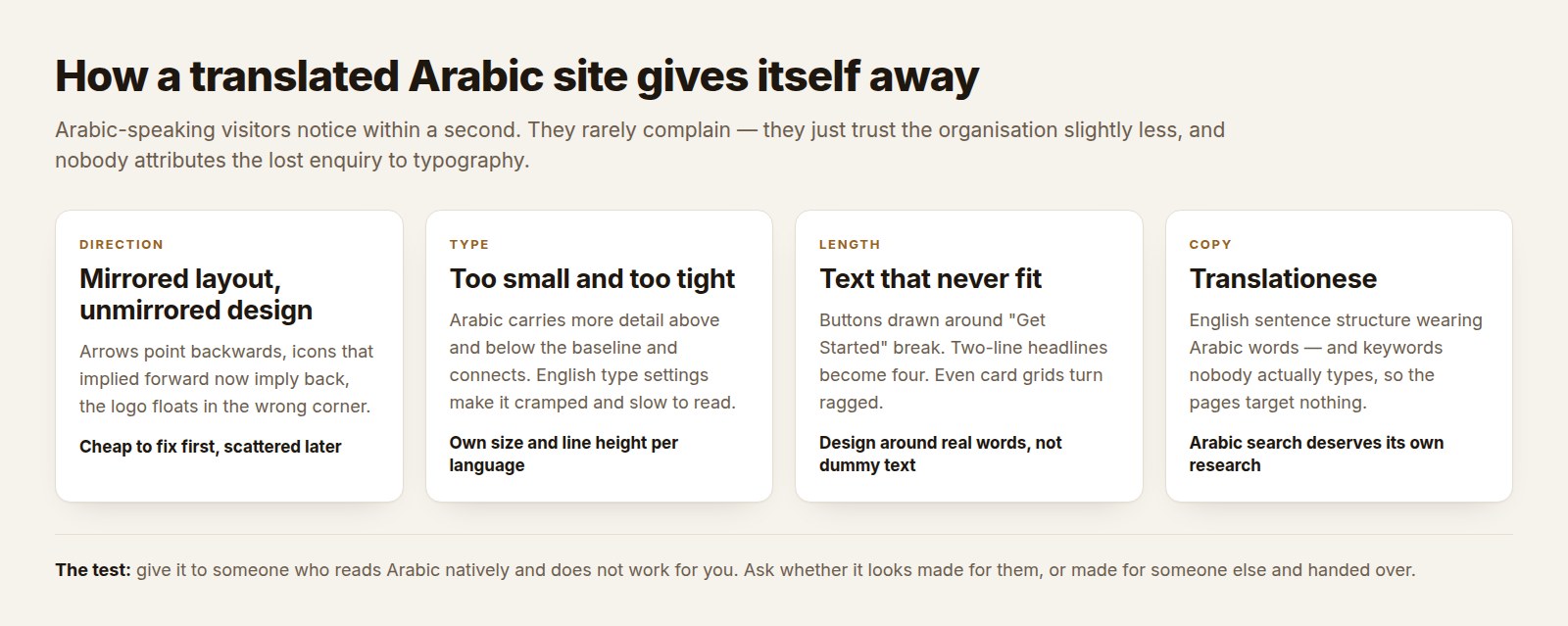
The direction is flipped but the design is not
Switching to right-to-left mirrors the layout, and a design that was never considered in mirror image starts to fall apart. Icons that implied forward now point backwards. Arrows on buttons face the wrong way. A logo that anchored the top-left is now floating in the wrong corner. Progress indicators run against the reading direction.
None of these is difficult to fix. They are only expensive to fix afterwards, because by then they are scattered across forty components.
The type is too small and too tight
This is the most common and most damaging one. Arabic letterforms carry more detail below and above the baseline than Latin ones, and they connect. At the font size and line height that look elegant in English, Arabic looks cramped and reads slowly.
Arabic usually needs a slightly larger size and noticeably more line height. Not a lot — but a site that uses identical values for both languages has demonstrably not been looked at in Arabic by anyone who reads it.
Text length was never accounted for
Arabic translations of English UI text are frequently longer, and sometimes much shorter. Buttons designed to fit “Get Started” break on the Arabic equivalent. Headlines that balanced in two lines become four. Card grids that were even become ragged.
A design that fits real Arabic text survives. One drawn around Latin dummy text does not.
Numbers, dates and mixed content
Latin numerals inside Arabic text, phone numbers, prices, dates, English product names, URLs — all of these sit inside a right-to-left flow and can reorder in surprising ways if the markup does not mark them properly. Everyone has seen a phone number rendered with its country code stranded at the wrong end.
The content is translationese
The deepest problem is not visual. Translated marketing copy reads as translated: English sentence structure wearing Arabic words, idioms that do not land, a register that is either stiffly formal or oddly casual.
It also fails commercially. Arabic search uses different phrasing from English search, so translated pages target words nobody actually types. If a large share of your buyers search in Arabic, translating your English keywords is leaving the easier half of the market alone.
What Arabic-first actually means
Not building the Arabic site first. It means both languages being real inputs to the design:
- The layout is checked in both directions before it is signed off, not after launch
- Type scale and line height are set for each language rather than shared
- Components are built with logical CSS properties so mirroring is automatic rather than a second stylesheet, which is standard practice in the WordPress builds I do
- Copy is written in Arabic where it matters, not translated — at minimum the headlines, the calls to action and the service pages
- Arabic keyword research is done separately, and Arabic pages are allowed to differ from their English counterparts
- hreflang tells search engines the two versions are the same page, so they consolidate rather than compete — which matters more now that ranking and being recommended are separate jobs
Why it keeps happening, even to people who care
Nobody sets out to build a second-class Arabic site. It happens because of the order the work is done in, and the order feels sensible at every step.
The English design is approved first, because that is where the decision-makers are most comfortable judging it. The build follows the approved design. Arabic arrives at the end as content, delivered as a spreadsheet of translated strings, dropped into a layout that was never asked whether it could hold them. By the time anyone sees Arabic in the actual interface, the design is signed off, the build is done, and what is left is the budget for fixes rather than for decisions.
The fix is not more effort at the end. It is seeing Arabic earlier: in the first design, at real length, in the real typeface. A designer who has watched a headline grow by a third while the button beside it stays fixed will design differently, and that costs nothing at the start.
What it costs when it is wrong
The damage is rarely dramatic, which is why it survives. Nobody complains. They simply switch to English, or they leave.
Switching is the outcome companies misread most badly. The analytics show most users on the English version, and that gets reported as evidence that the Arabic side does not matter. It is usually evidence of the opposite: people tried Arabic, found it harder to read than English, and went where the experience was better. The number is real and the conclusion drawn from it is backwards.
The second cost is search. A translation layer that does not produce separate, indexable URLs cannot rank in Arabic at all, so the audience that would have found you in their own language never arrives to be counted. You then look at your traffic, see it is mostly English, and confirm the wrong belief again.
Building Arabic-first rather than correcting Arabic-second is how my company works, across the GCC from Kuwait: website design and development at Tothiq.
Frequently asked questions
Can we not just use a translation plugin?
For understanding a page, sometimes. As the Arabic version of your business, no. A translation layer typically does not give you separate indexable URLs, which means it cannot rank in Arabic and cannot be found by someone searching in Arabic. It also translates the words without touching the layout, so every problem described above stays exactly where it was.
Which Arabic typeface should we use?
Less important than the size and spacing you set it at. Arabic letterforms carry more detail in less height than Latin ones, so the same point size reads smaller and the same line height reads tighter. Whichever family you choose, expect to increase size and line spacing relative to your English settings rather than mirroring them. A face chosen for screen reading beats one chosen for looking authentically Arabic.
Do we need two separate websites?
No, and you should not. One site, one codebase, with the layout built using logical properties so direction flips correctly rather than being overridden per element, and separate indexable URLs per language. Two separate sites double the maintenance and guarantee the two drift apart, which is a worse version of the same problem.
Our analytics say hardly anyone uses the Arabic version. Does that settle it?
It settles less than it appears to. If the Arabic version is harder to read, people switch to English and the numbers record that as a preference. If it has no indexable URLs, people searching in Arabic never arrive at all. Both produce the same chart. Before treating low Arabic usage as a verdict, check whether Arabic was ever genuinely available to be chosen.
We already launched. How much of this can be fixed without rebuilding?
More than you would expect. Type size, line height and spacing are usually a stylesheet change. Text-length breakage is often a handful of components rather than the whole layout. What is genuinely structural is the URL question: if Arabic exists only as a translation layer, that part is a rebuild of how the site serves languages, not a tweak. Establish which side of that line you are on before agreeing to anything larger.
One last point, because it reorders the priorities for most people: good Arabic on your site is not a courtesy extended to an Arabic-speaking audience. It is the condition of that audience finding you at all. A version that is not indexed is not found; a version that is indexed but hard to read loses the people who found it. So the order is: exist as a separate page first, then be easy to read, then be written by someone who thinks in the language. Most sites are attempting the third having failed the first.
The test
Give the Arabic version of your site to someone who reads Arabic natively and does not work for you, and ask one question: does this look like it was made for me, or made for someone else and handed to me? You will not need to ask a second one.