Every AI company selling to UAE businesses now has the same line in its proposal: “our forward deployed engineers will work with your team.” Sometimes that means an experienced engineer who will sit inside your company and build on your systems until the result is measured. Sometimes it means a pre-sales team with a new title. The difference decides who ends up owning what gets built, so it is worth knowing how to tell them apart before you sign.
This is a buyer’s guide to that question: where the offers come from, whose interests each one serves, and the four questions that separate a real forward deployed engineer from a renamed sales role.
Why every vendor is offering one
The role started at Palantir and spread across the AI industry once companies discovered how wide the gap is between a model that works in a demo and a system that works in a business. The clearest sign of where it has gone came in May 2026, when OpenAI launched a majority-owned subsidiary built entirely around the idea. Decrypt reported that the OpenAI Deployment Company started with more than $4 billion in committed capital, nineteen backers including McKinsey, Capgemini and Goldman Sachs, and a deal to acquire a UK consultancy with about 150 engineers.
The economics behind this were set out a year earlier by Andreessen Horowitz in “Trading Margin for Moat”. The argument is that enterprise AI needs so much hands-on setup that software companies should accept lower margins and do the setup themselves, because a product that has been wired deep into a customer’s work is very hard to replace.
Read that sentence from the buyer’s side. When a vendor pays an engineer to work inside your company, part of what that engineer is building is the vendor’s position in your business. That is not a scandal, and often the work is excellent. But it means the engineer’s job description and yours are not identical, and the contract has to cover the difference.
The three kinds of offer you will see
The vendor’s engineer. Provided by the model company or platform you are buying. Usually strong on their own product and quick to show results. Their work tends to deepen your use of that product, and they leave when the vendor decides the account is running.
The integrator’s engineer. Provided by a systems integrator or consultancy, billed by the day or by the project. Often neutral between products, but paid for time rather than outcomes, so the incentive to finish quickly is weaker than it looks.
The independent engineer. Hired by you, answering to you, with no product to sell. Usually a smaller operation, so you get one senior person rather than a team, and you need to check that they can build as well as advise.
In the UAE you will sometimes meet all three on the same project: a global platform offering its engineer, a local integrator connecting it to your systems and an independent adviser brought in to review. The most important question then is who decides when they disagree, and who confirms that the result has been achieved. If that is not written into the contract, it is eventually settled by whoever owns the account the code runs in.
Any of the three can be the right choice. What matters is that you know which one you are buying, and that the same four questions get asked of each.
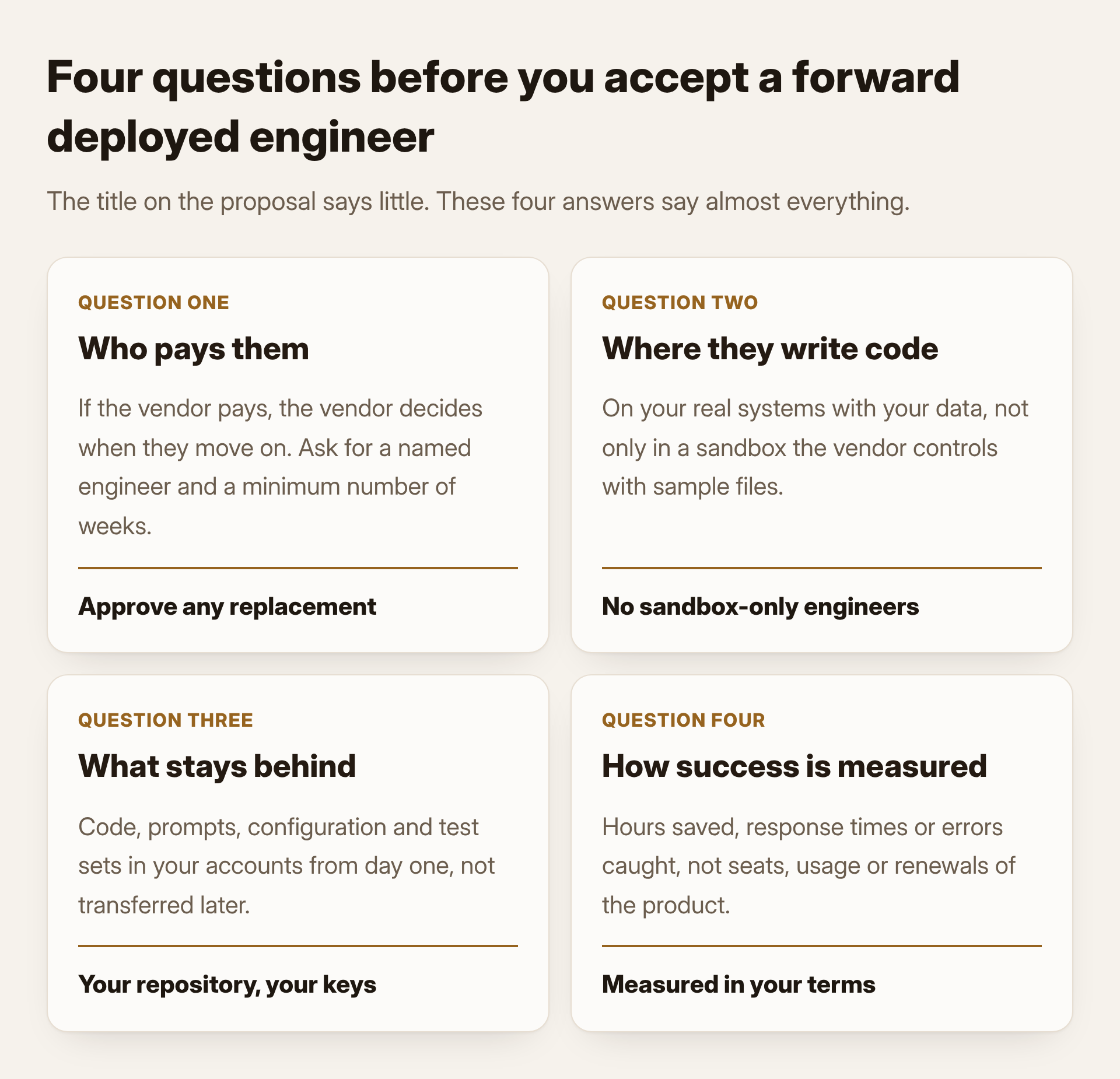
Four questions that settle it
Who pays them, and who can end the engagement?
If the vendor pays, the vendor decides when the engineer moves to the next account. Ask how long the engineer is committed to your project, what happens if they are reassigned and whether you can ask for a replacement. If you pay, ask what happens if they become unavailable, because an independent engineer is a key-person risk of a different kind.
Whose systems do they write code in?
This is the line Gergely Orosz draws in his explainer on the role: solutions architects advise and rarely write code on the customer’s infrastructure, usually building proofs of concept on anonymised or offline data, while forward deployed engineers write code directly on the customer’s systems. If the person you are offered will only ever work in a sandbox the vendor controls, they are not doing the forward deployed job, whatever their business card says.
What stays when they leave?
Ask for the code, prompts, configuration and test sets to live in your accounts from the first day, not to be “transferred later”. Ask whose cloud account holds the API keys and the logs. In the UAE this question also touches where data is stored, which I have covered in the questions to ask before connecting a model to a live system.
What is success measured by?
A real forward deployed engagement starts with a measure in your business’s terms: hours saved, response times, errors caught, revenue protected. A sales engagement measures adoption of the product: seats, usage, renewal. Both can be legitimate, but only the first one tells you whether the work paid for itself.
Signs the title is only a title
A proposal usually gives itself away before any engineer arrives. These are the patterns worth a second look:
- No engineer is named, only “a dedicated team”, and nobody can say how many weeks they will spend with you.
- Every example in the demonstration runs on the vendor’s sample data, never on a document or conversation of yours.
- The plan has no period in which the engineer sits with the people who do the work today.
- Success is described as adoption, activated licences or “users onboarded”.
- The code and prompts will live in the vendor’s workspace “for now”, with a transfer promised later.
- Arabic is listed as supported, but nobody asks for your real Arabic emails, forms or calls to test against.
One of these on its own may be an oversight. Three or more usually mean the engagement is a sales motion with engineering language on top. The fix is not to walk away, but to ask for the missing piece in writing and see how the vendor responds.
Why the real ones are scarce, and expensive
Demand for the role has grown far faster than supply. Paraform’s 2026 guide to hiring forward deployed engineers cites an analysis of a thousand job postings showing growth of more than 1,100% in a year, with a median base salary above $170,000 in the United States. The same guide cites research by Standard and Poor’s Global Market Intelligence showing the share of companies abandoning most of their AI initiatives before production rising from 17% to 42% in a single year.
Two practical conclusions follow for a UAE buyer. First, an offer of a team of forward deployed engineers at a low day rate deserves a polite question about who exactly those engineers are. Second, the failure rate is exactly why the role exists: most AI projects do not die because the model was weak, but because nobody stayed long enough to make it work on real data.
Terms that protect you in any of the three cases
- A named engineer, with a minimum commitment in weeks, and your right to approve any replacement.
- A written success measure agreed before the build starts.
- All code, prompts and configuration in repositories and cloud accounts you own.
- A test set of your real examples, in Arabic and English where the work is bilingual, handed over with the system.
- Monthly running costs reported from the first week, so the bill after launch is not a surprise. I have written about what an assistant costs to run for a year.
- A person on your side who shadows the work and can take it over.
These are the same checks I apply in technical due diligence before anyone buys or builds. They cost nothing to ask for at the proposal stage and a great deal to add afterwards.
Where an independent fits
The vendor’s engineer and the independent one are not really competitors. The arrangement that works best is often both: the vendor’s engineer brings deep knowledge of the product, and someone who works for the buyer decides what should be built, checks the work against the business measure and makes sure the company can run it alone.
That second role is the one I take. I have built more than a hundred digital products over two decades, including my own platforms, so I can build the first version myself rather than only review someone else’s. And because I sell no model or platform, the recommendation on which product to use is not tied to who is paying me. For many UAE companies that is the same seat a fractional CTO fills, applied to one AI project at a time. My conversational AI consulting is usually where that work begins.
Frequently asked questions
Is a forward deployed engineer from a vendor a bad idea?
No. They often know the product better than anyone. Just be clear that they work for the vendor, and put ownership of code, data and test sets in your contract so the work stays yours.
How is a forward deployed engineer different from a solutions architect?
A solutions architect mostly advises and builds proofs of concept on sample data. A forward deployed engineer writes code on your real systems, with your real data, and stays until the result is measured.
Should the engineer be based in the UAE?
Some time on site matters, especially at the start, to watch the work being done and meet the people doing it. After that much of the build can be remote, with regular visits to test with users.
How long should a first engagement last?
Long enough to measure one use case on real data, usually six to eight weeks. If no measured result exists by then, stop or change direction rather than extend.
Can we start with the vendor’s engineer and bring in an independent later?
Yes, but it is cheaper to set the ownership and measurement terms at the start. An independent reviewer brought in after six months often spends the first month finding out what was actually built.
Before you sign
The title on the proposal tells you very little. The four answers tell you almost everything: who pays the engineer, where they write code, what stays behind and how success is measured. Get those in writing, whichever kind of engineer you choose, and the forward deployed model does what it promises: it makes AI work inside your business, and leaves it there.