The UAE is moving business-to-business invoicing onto a structured electronic model, exchanged through accredited service providers rather than emailed as PDFs. The programme has been announced with a phased rollout, and the phases and thresholds have moved more than once — so check the current dates against the Ministry of Finance eInvoicing programme and the Federal Tax Authority rather than against anything you read in a blog post, including this one.
What has not moved is the shape of the obligation, and that is the part worth preparing for now. Because almost every conversation I have had about this has been with a finance team, and that is the wrong department to be holding it alone.
What actually changes
Today, most invoices are documents. A PDF is generated, emailed, and a human on the other side reads it and types things into their system. It works because people absorb the inconsistencies.
Under a structured model, an invoice is data with a required shape, transmitted through a provider, and validated. There is no human to absorb inconsistencies. A field that your system leaves blank, or fills with something approximate, becomes a rejection.
That is why this is a systems project. The question is not “can finance produce this format” — it is “does the data even exist in our systems, correctly, at the moment the invoice is raised”.
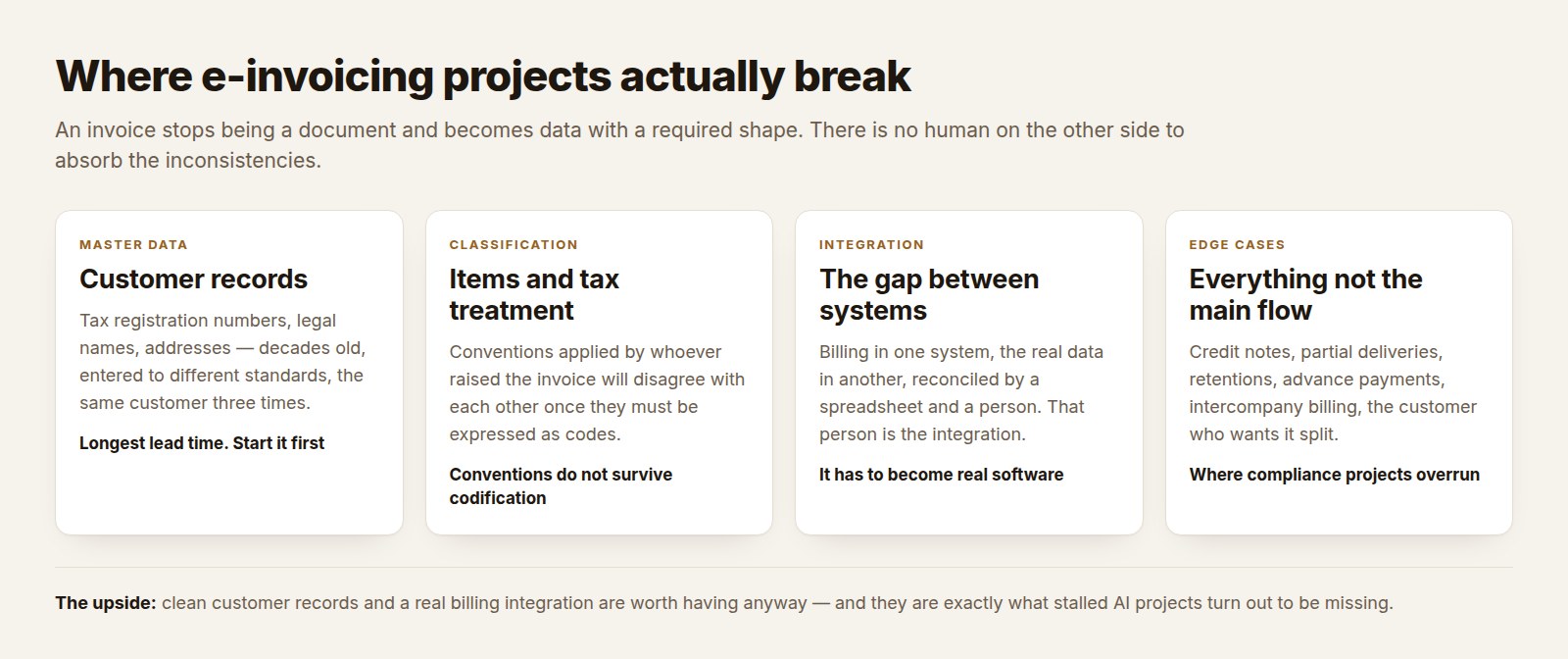
The four places it usually breaks
Customer master data
Tax registration numbers, legal entity names, addresses. In most businesses this data is decades old, entered by different people to different standards, with the same customer existing three times. It has been survivable because a human reads the invoice. It stops being survivable.
Item and tax treatment
Structured invoicing wants consistent classification. Businesses that have been applying tax treatment by convention, or by whoever raised the invoice, will find those conventions disagree with each other once they have to be expressed as codes.
The gap between systems
Many companies raise invoices in one system and keep the underlying data in another, reconciled by a spreadsheet and a person. That person is the integration. When the invoice has to be produced automatically and correctly at the moment of issue, that arrangement has to become real software.
Everything that is not the main flow
Credit notes, partial deliveries, retentions, advance payments, intercompany billing, the customer who always wants it split across two entities. These edge cases are where compliance projects overrun, and they are invisible until someone maps the real process rather than the documented one.
What to do now, before the dates matter
- Find out what you actually issue. Not the process document — a month of real invoices, including the awkward ones.
- Audit customer master data for completeness. This is the longest lead-time item and it is pure grind. Starting it early costs nothing and starting it late costs everything.
- Establish where invoice data lives and whether it can be produced without a human assembling it.
- Ask your ERP or accounting vendor for their roadmap in writing. “We will support it” is not a plan. Ask which version, when, and what it requires of you.
- Decide who owns it. If the answer is finance alone, it will arrive late. This is exactly the kind of decision fractional CTO work exists for.
Who owns this, and who usually gets handed it
It lands on finance, because it has the word invoicing in it. That is the single most reliable predictor of a difficult project.
Finance owns the invoice as a document. What is changing is the invoice as a data structure moving between systems, which is owned by nobody in most companies. So the finance team is asked to deliver something that depends on the ERP, the sales system, the customer master data and whatever spreadsheet the branch in the next emirate has been using for six years — none of which they control.
The workable arrangement is finance owning the outcome, with someone technical owning the delivery, and both of them able to reach the person who can force a decision when two systems disagree about what a customer is called. Without that third person the project stalls at the first data conflict, and it always reaches a data conflict.
The questions that reveal whether you are ready
Four of them, and you can answer all four this month without buying anything.
Can you produce a list of every system that issues an invoice? Not should issue. Does issue. Most companies discover at least one they had forgotten, usually a branch or a legacy product line.
Does a customer have one identity across those systems? If the same client is three records with three spellings, everything downstream inherits that.
Are your invoices generated from data or assembled by a person? A template someone fills in by hand is not a source you can automate from; it is a document that happens to contain numbers.
When something is rejected, who finds out? Structured exchange means machine-readable rejections. If those land in an unmonitored inbox, you will discover the failure from a customer chasing payment.
Companies that can answer these four are nearly ready regardless of which software they buy. Companies that cannot will find that no software rescues them, because the software is not the part that is missing.
Where the break turns out to be reading documents rather than changing the ledger — pulling identifiers and line detail out of invoices and contracts you already hold — that is a separate build: document intelligence, which my company Tothiq does.
Frequently asked questions
When do we actually have to be ready by?
Take the dates from the Federal Tax Authority directly rather than from an article or a vendor, because phasing has moved before and the sequence depends on the size and category of the business. What is worth planning around is not the deadline but the lead time: the systems work described here takes months and does not compress well, so a date that looks comfortable in an announcement is usually less comfortable once you have listed the systems involved.
Can our accounting software just handle this for us?
It will handle its own part, and that part is real. What it cannot handle is data reaching it in an inconsistent state from systems it does not control, or a customer record that exists three times. Every serious problem I have seen in this work sits upstream of the accounting package rather than inside it, which is exactly why treating it as a software purchase misses the cost.
We are small and issue a few invoices a month. Is this still a project?
Smaller, but not nothing. The volume is not what makes it work; the consistency is. A company issuing twenty invoices a month from one system with clean customer records has a genuinely small job. A company issuing the same twenty from three places, with a spreadsheet in the middle, has the same problem a large company has, only cheaper to fix.
What happens if an invoice is rejected?
It has not been issued, whatever your own system shows. That is the shift people find hardest: your records and the record that counts can diverge, and the gap is silent unless somebody is watching for it. Decide before you go live who monitors rejections and how quickly, because the answer determines whether a formatting error costs you an hour or a payment cycle.
Is there any benefit to us, or is this purely compliance cost?
There is a real one, and it is the reason this is worth doing properly rather than minimally. Once invoices leave your systems as structured data, you have a clean, complete, machine-readable record of what you sold, to whom, when and at what price. Almost every useful thing a company wants from AI or analytics depends on exactly that, and most companies do not have it. The compliance work builds the foundation whether or not you intended it to.
The upside nobody mentions
Structured invoicing forces the data hygiene most businesses have deferred for years. Clean customer records, consistent item classification and a real integration between billing and operations are worth having regardless of the mandate. Several of the AI and automation projects that stall in UAE companies stall for exactly these reasons — the data was never good enough. If you are going to be made to fix it, you may as well collect the benefit.